
A new stablecoin deserves a check of its issuer, backing, authentic contract and usable exit before you consider acquiring it. A launch announcement is evidence that a company has announced a product, not proof of universal access or guaranteed stability.
This guide reviews selected 2026 developments checked on November 26. It also provides a way to evaluate upcoming projects without inventing launch dates, tradable contracts or expected returns.
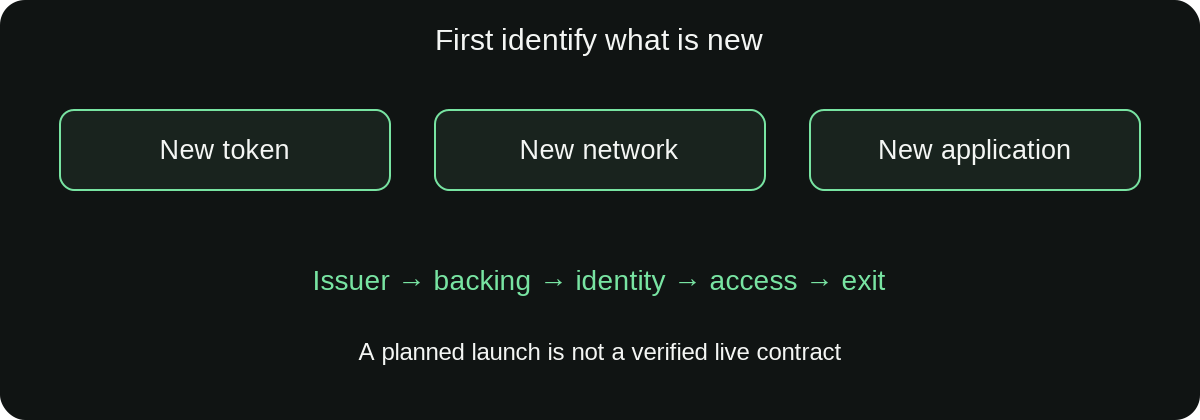
First decide what is actually new
News can describe a new token, an existing token deployed on another chain, a new distribution partner or a financial product using an existing stablecoin. Those are different events with different implications.
A new chain deployment requires a network and asset-identity check. A new lending vault adds application risk. A new issuer licence concerns legal permission. None of those necessarily means a new stablecoin has been created.
Write the event in one precise sentence before comparing it with another announcement. For example, “an issuer announced a dollar-targeting token” is different from “an exchange added deposits for an existing token.” This prevents marketing language from expanding the claim.
For updates involving an established token, the PYUSD article illustrates the separation between issuance, account features and external applications.
USA₮: distinguish the new token from USDT
Tether’s January 27, 2026 launch announcement identifies USA₮ as a separate product and Anchorage Digital Bank N.A. as its issuer. Tether support for the product should not be confused with Tether being its issuer.
The announcement also states that the token is not US legal tender and is not government guaranteed or protected by FDIC or SIPC insurance. A federally regulated issuer description does not erase those distinctions.
For a user, similar branding creates an asset-identification task. Confirm the token identifier, chain and receiving service. Do not send one product to a deposit address intended for another merely because both target dollars and share part of a name.
Also avoid treating the issuer’s description of regulatory positioning as proof of every possible approval. Check the specific status and terms relevant to your account and transaction.
USDPT: a payment-network launch still needs a route check
Western Union’s May 4, 2026 announcement reports the launch of USDPT on Solana and identifies Anchorage Digital Bank N.A. as issuer. The company describes an intended role in payment infrastructure.
That does not mean every Western Union location or customer automatically supports every USDPT transaction. Separate the issued token from the rollout of customer-facing services, markets and features mentioned in the announcement.
If the intended use is a remittance, verify funding, recipient access and final payout. A chain-level launch is only one part of delivering usable money. A token can exist while a particular retail corridor remains unsupported.
Keep company-reported aims distinct from independently observed outcomes. A launch release can establish the product’s stated design and date, but it cannot provide a measured multiyear operating history on its first day.
Upcoming does not mean available for purchase
A planned product may depend on regulatory permission, technical work, partner integration or internal decisions. A target quarter is not a binding promise to every prospective user. A licence likewise does not prove a token is already circulating publicly.
For example, HSBC’s April 2026 statement described a planned HKD stablecoin launch in the second half of 2026. That historical plan alone should not be presented as confirmation that a particular product or contract is live on November 26.
Verify a subsequent launch document and official asset details before labeling an upcoming project as launched. If those are unavailable, preserve the uncertainty rather than creating a ticker, contract or purchase tutorial.
Be especially wary of private messages offering early allocations. A dollar-targeting payment token does not inherently offer the capital appreciation narrative associated with a speculative presale.
Evaluate five evidence gates before acquiring a token
The first gate is a named issuer or defined protocol arrangement. Establish who owes what to holders and which legal entity appears in the terms. A project website with anonymous branding leaves that question unresolved.
The second gate is support for the target value. Identify reserve assets or stabilization mechanisms and the independent evidence available. A promise of future reports is weaker than an existing dated report.
The third gate is the authentic deployment. Obtain the network and contract or mint identifier through official documentation. Search results, wallet logos and ticker matches are not enough.
The fourth gate is your access. Check jurisdiction, account eligibility and supported transaction sizes. A product designed for institutions may not provide retail minting or redemption.
The fifth gate is exit. Determine whether you would redeem with an issuer, sell through a market or use another service. Inspect costs and expected timing before assuming the target price is personally available to you.
Keep a launch watchlist with useful fields
Record the announcement date, issuer, reference currency, network, status, source and next item to verify. Use status labels such as announced, launched or available through a specified service, with a date attached.
Avoid ranking new products by an unsupported safety score or a projected market capitalization. Track evidence becoming available instead: authentic deployment documents, reserve disclosures and a workable route for the intended users.
For older and newer assets alike, the reserve-report interpretation guide helps assess financial evidence. The token verification guide addresses scams that borrow credibility from genuine launch news.
Questions about new projects
Does a new stablecoin need a speculative presale to maintain its peg?
Do not assume so. Examine how issuance is supposed to work and what funds support the resulting obligation. A presale pitch promising appreciation needs separate scrutiny from a payment token’s stated target value.
Can I rely on the first exchange listing as proof of authenticity?
Confirm the exact issuer-linked contract and the venue’s supported network. A listing is a distribution event, not a substitute for understanding the asset, holder rights or the platform’s own risks.
Does a low early supply make a stablecoin undervalued?
No. A stablecoin’s intended unit value follows its reference and mechanism, not scarcity alone. Low circulation can also mean limited adoption or liquidity; it is not a reason to predict appreciation.