
A stablecoin reserve attestation is not automatically a full financial-statement audit. To understand what an accountant has verified, read the engagement’s subject, criteria, dates and conclusion. The word “audited” in a marketing headline cannot answer those questions for you.
The practical task is interpreting the independent report, not simply finding a reserve balance. A credible document can provide valuable evidence while leaving important questions outside its scope.
Find the actual engagement document
Start with the issuer’s official transparency archive and open the accountant’s signed report. A company summary, dashboard or screenshot may accurately repeat selected numbers, but it does not replace the independent conclusion and its qualifications.
Check that the issuer entity in the report corresponds to the token you are investigating. Groups can operate multiple products and entities. Assurance about one company or defined token obligation should not be silently extended to every affiliate.
Record the report’s publication or signature date separately from its measurement dates. A November publication describing October balances is October evidence. Visiting the archive today does not turn that evidence into a continuous real-time examination.
For the broader search process, the reserve-proof checklist helps locate the relevant evidence. Here, the focus is what the accountant’s words allow you to conclude once the document is open.
Identify exactly what management asserted
An attestation commonly evaluates a management assertion against specified criteria. That assertion may concern reserve composition, outstanding redeemable tokens and whether defined assets meet defined obligations at selected times.
Read the definitions before comparing totals. Gross tokens on several chains may differ from tokens treated as issued or redeemable under the report. Pending minting, redemptions, restricted balances and timing adjustments can change the denominator.
The question is not whether a bigger number appears above a smaller number. It is whether the right assets and obligations have been identified consistently. If you substitute raw on-chain supply for the report-defined obligation, you may manufacture a discrepancy rather than discover one.
Also locate the valuation basis. Market value, amortized cost and other permitted measurements answer different questions. An asset counted at one basis should not casually be described as cash immediately available at that same amount.
Read the conclusion and the standard together
The accountant’s conclusion should identify the assertion, criteria and applicable assurance framework. Determine whether the engagement offers reasonable or limited assurance, and whether the wording is qualified or otherwise modified. These distinctions are not interchangeable confidence labels.
For example, the BDO report attached to Tether’s September 2026 figures uses ISAE 3000 Revised and addresses specified financial information at a point in time. It should not be relabeled a full IFRS financial-statement audit.
The October USDC examination likewise needs to be read against its defined assertion and measurement dates. An examination of reserve information is not the same assignment as auditing all of a corporate group’s financial statements.
Do not infer that an engagement with a narrower subject is worthless. Its usefulness comes from answering a defined question accurately, not from pretending it answers every possible question about the business.
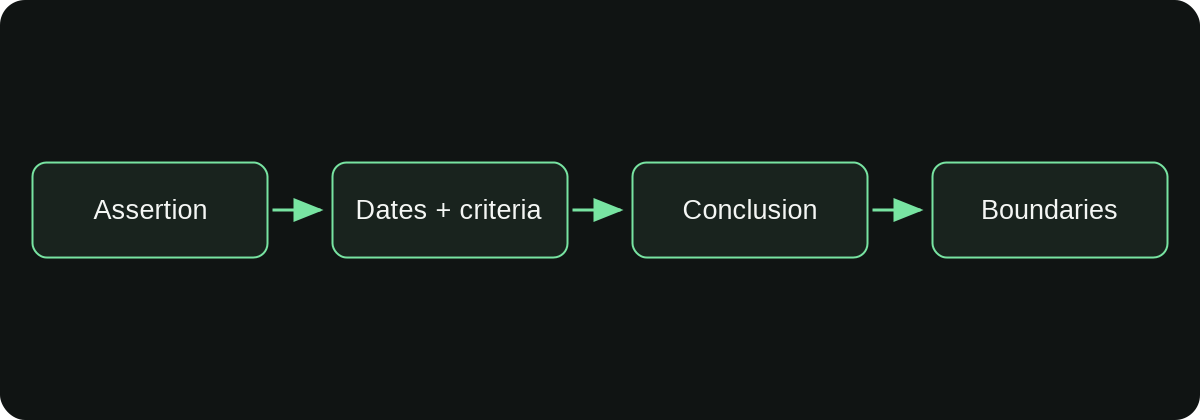
Treat limitations as part of the evidence
A report may explain that balances are measured only at selected times, that certain information comes from management or that external websites are outside the work performed. Read those boundaries alongside the favorable conclusion.
The September PYUSD report, for instance, states that information on referenced websites has not been subjected to its examination procedures. A link inside the document does not automatically bring every linked claim within the accountant’s assurance.
Point-in-time evidence also cannot establish every intervening day’s condition. Ask what additional reporting, controls or disclosures address changes between measurements. Do not invent daily verification from two tested dates.
A limitation is not automatically an allegation of wrongdoing. It identifies where you need another source, a different engagement or a more cautious conclusion. Distinguish missing evidence from evidence that something is false.
Translate the report into a bounded conclusion
A useful reading note has five fields: entity, subject, dates, criteria and conclusion. Add explicit unanswered questions, such as your personal redemption access, immediate market liquidity or the operational reliability of an intermediary.
For illustration, a note might say: “The accountant examined management’s stated reserve coverage at two specified dates; this does not establish my exchange’s withdrawal availability today.” That is more informative than simply writing “audited and safe.”
If the report includes assets above obligations, calculate the difference but preserve its definition. Do not turn it into a personal insurance fund, a guaranteed recovery percentage or a universal score for comparing unrelated issuers.
Compare consecutive reports only after checking whether criteria changed. A new asset category, entity boundary or circulation definition can make an apparent movement partly a reporting change. Reconcile the scope before interpreting a trend.
Know what a reader cannot verify alone
You can inspect arithmetic, consistency, dates and the engagement description. You generally cannot reproduce private bank confirmations or obtain all evidence available to the accountant. Reading a PDF does not make you the issuer’s auditor.
Similarly, a blockchain explorer can show token activity but cannot independently establish ownership and unrestricted availability of every off-chain reserve asset. Combine sources according to what each can demonstrate.
For selected current documents and their dates, use the reserve-report directory. For a token choice, combine that evidence with the intended payment or exit route rather than stopping at the report’s headline.
Questions about assurance terminology
Does the accountant’s brand make every linked claim reliable?
No. Identify the particular engagement and subject covered. A well-known firm can perform work on a narrowly defined assertion without endorsing the issuer’s advertising, token price or unrelated products.
Should a PDF file’s checksum be treated as financial verification?
A checksum can help establish that a file has not changed from a known copy. It does not establish the accuracy of the underlying financial information or replace the accountant’s procedures.
Can I quote only the favorable sentence from an opinion?
That can mislead if it removes the subject, criteria or material limitations. Summarize the conclusion with enough context for a reader to understand what was examined and what remains outside the engagement.