
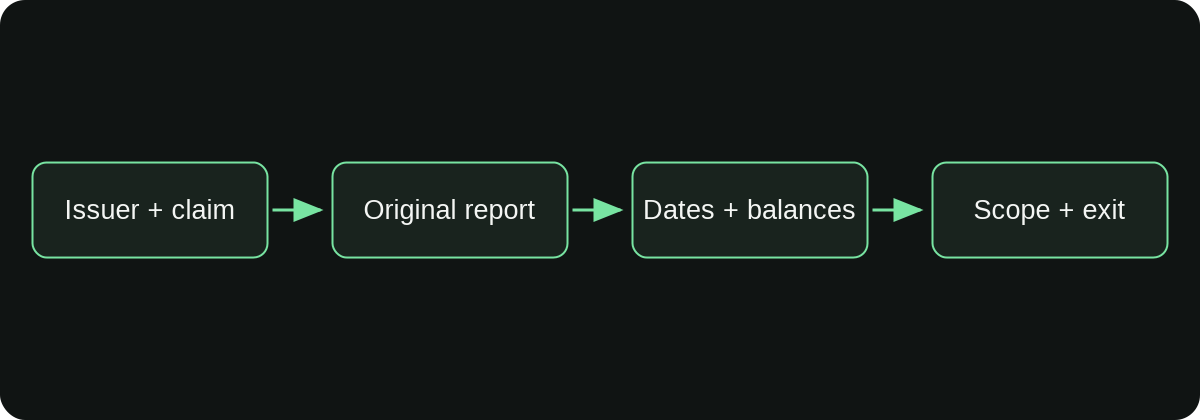
To check stablecoin reserve proof, identify the issuer and token, locate the original evidence, compare the defined assets with the relevant obligations and read the date and independent conclusion. An on-chain balance alone cannot prove that all off-chain liabilities are covered or that you can redeem immediately.
The task is an evidence check, not an attempt to recreate a professional audit from a dashboard. A useful result states what the material supports, which questions it does not address and whether the holder’s intended route needs additional verification.
Step one: identify the entity and the claim
Record the stablecoin, legal issuer, network and token version. A reserve report for one issuer does not necessarily cover another company with a similar name, a bridge representation or a yield-bearing receipt token issued by an application.
Then state the claim being tested. It might concern assets exceeding specified liabilities, token circulation at a reporting cutoff or an exchange holding customer assets. These are different subjects. Evidence that answers one should not be casually applied to the others.
Circle’s bridged-USDC documentation illustrates why the version matters. A representation can depend on a bridge arrangement even when it uses the name of a reserve-backed token. Identify the added claim before interpreting the issuer’s report as covering the whole route.
Step two: retrieve the original report
Start with the issuer’s verified disclosure archive, such as Circle’s transparency page or the link from Tether’s official reserve update. Open the underlying report rather than relying on a screenshot, translated summary or badge on an affiliate page.
Check the legal entity, report title, accountant and date. A familiar accounting-firm name on a promotional graphic is not sufficient. Preserve the actual document and source location so later corrections or replacements can be understood.
Avoid uploading wallet secrets or signing a transaction to read public reserve evidence. A site that demands a seed phrase to verify backing is asking for control of funds, not performing an ordinary document check.
Step three: distinguish measurement from publication
Find the dates when the assets and obligations were measured, the date of the accountant’s conclusion and the publication or retrieval date. They can all differ. A newly published document may describe a balance from several weeks earlier.
Tether’s Q3 assurance report explicitly limits its conclusion to the specified reporting point. Circle’s October examination report uses its own defined reporting dates. These are examples of why a dated independent conclusion should not be relabeled continuous real-time coverage.
If the question concerns current availability, add the latest service and redemption notices. A historical report can remain valid evidence about its subject while being insufficient to describe every event occurring afterward.
Step four: read assets and obligations on compatible terms
Identify which assets are included, how they are valued and which liabilities or circulation measure forms the comparison. Gross token supply, eligible circulation and total company liabilities may be different fields with legitimate reconciliations.
Inspect definitions, exclusions and timing adjustments before calculating coverage. Do not treat a blockchain supply total as automatically equivalent to the report’s liability figure. Equally, do not assume every exclusion is irrelevant; understand what it means for the specific holder and claim.
| Evidence field | Question to answer |
|---|---|
| Assets | Which holdings and valuations are included? |
| Obligations | Which token or company liabilities are compared? |
| Adjustments | What is excluded, offset or pending settlement? |
| Date | When were both sides measured? |
| Accessibility | How can the backing support eligible redemptions? |
A simple assets-minus-liabilities calculation can verify internal arithmetic. It cannot by itself establish asset ownership, liquidity or legal priority. Those questions require the rest of the evidence and applicable terms.
Step five: read the independent conclusion with its scope
Identify the engagement type and subject. Reasonable assurance is meaningful, but it is not absolute certainty. A reserve-specific examination or assurance report should not be renamed a full corporate financial-statement audit without checking what was actually performed.
Read qualifications, emphasis paragraphs and limitations alongside the conclusion. A statement that a defined assertion is fairly presented at particular dates does not promise that all future redemptions will clear, all market prices will remain stable or every affiliated business is financially sound.
Also separate the issuer’s assertion from the independent practitioner’s work. Both may appear in one PDF. Attributing management’s full promotional wording to the accountant can materially overstate what the independent conclusion says.
Step six: understand the limit of on-chain proof
A wallet balance can show assets held at an address under the chosen network’s rules. It does not automatically establish who beneficially owns them, whether they are borrowed or pledged, or what off-chain obligations must be met.
An exchange proof-of-reserves process may use cryptographic methods to address certain customer balances. Its coverage and liability treatment still need inspection. It is not interchangeable with an issuer’s off-chain reserve evidence merely because both use the word proof.
For a reserve-backed stablecoin, combine the relevant chain reconciliation with the legal and financial material. For a crypto-collateralized design, inspect the protocol’s collateral, debt, oracle and liquidation rules. The evidence method must fit the mechanism being evaluated.
Step seven: verify the holder’s route separately
Even credible coverage evidence does not establish access for every user. Check direct-redemption eligibility, minimum amounts, fees, supported bank routes and any restrictions. If relying on an exchange sale instead, inspect its market and withdrawal conditions.
The USDT-versus-USDC guide applies that distinction to practical selection. A strong report cannot guarantee an unrelated intermediary’s solvency or prevent a wrong-network transfer. Documentary backing and an operational exit are separate requirements.
Record the supported finding in plain terms, such as a defined report covering a specified entity and date. Keep unresolved questions visible without converting them automatically into either reassurance or an accusation. Evidence is most useful when its scope matches the decision being made.
Frequently asked questions
Does a checksum or file hash prove the report’s financial claims?
It can help identify whether a file matches a known version, but it does not establish that the underlying figures are correct. Authenticity and substantive financial evidence are different checks.
Can I compare two coverage ratios without reading the footnotes?
Not reliably. Asset valuation, liability definitions, exclusions and dates can differ. A ratio using mismatched subjects can look precise while comparing unlike claims.
What if the issuer replaces a report after publication?
Preserve the earlier version and read the correction or explanation. Determine whether the change affects a decision or calculation rather than assuming the replacement is either immaterial or evidence of wrongdoing by itself.