
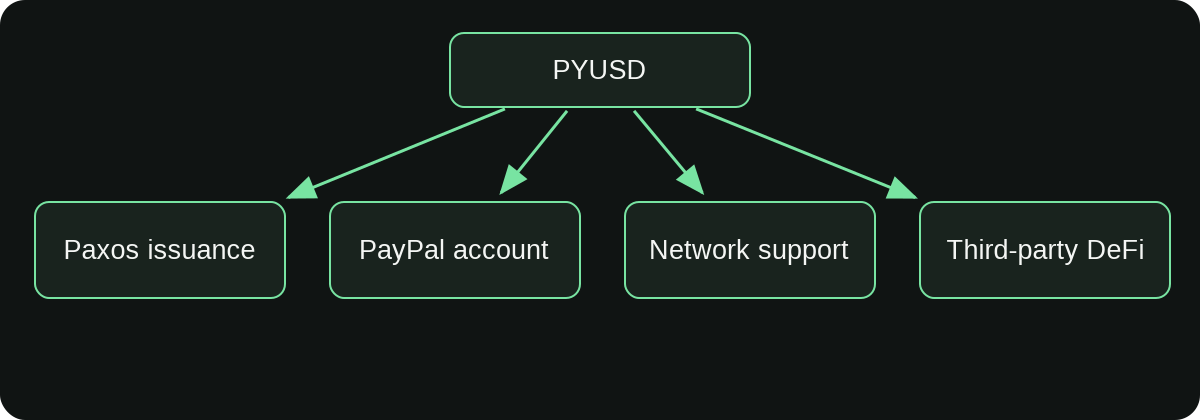
PYUSD is PayPal’s dollar-targeted stablecoin, issued by Paxos. The latest developments involve several distinct layers: reserve disclosures, account-level payment features and third-party on-chain applications. An expansion in one layer does not automatically change the rights or features of every holder.
This update was checked on November 26, 2026. It identifies observation dates and announcement sources rather than presenting old reserve figures as a current live balance.
November 25: a new lending use case on StableChain
In a November 25 announcement distributed by PR Newswire, Stable reported the launch of the StableEarn Prime PYUSD Vault on Morpho, curated by Galaxy. The associated borrowing market uses ether.fi’s weETH as its sole collateral asset at launch.
This is a company announcement about third-party lending infrastructure. It is not evidence that an ordinary PayPal account balance has automatically entered that vault or gained the same functionality.
For a holder considering it, the important question is what changes after a deposit. Lending replaces a simple token holding with a position exposed to contracts, available liquidity and the lending arrangement. Neither a recognizable stablecoin nor a named curator removes those additional conditions.
Before interacting, verify the official deployment, eligibility, current parameters and withdrawal route. Do not substitute an announcement link for understanding the transaction you are authorizing. A launch establishes a product claim, not an independently measured return history.
October network support is not the same as universal app support
Paxos’s October 8, 2026 product update states that PYUSD is supported on Stable, an EVM-compatible network with chain ID 988, for deposits, withdrawals and transfers. This describes issuer-side infrastructure support.
A user still needs both sending and receiving services to support the exact network. Your wallet being able to display a token does not mean your exchange or PayPal account will credit a deposit from that chain.
Check the transfer screen for the account you actually use. Where a general help page lists fewer networks than a legal document or infrastructure announcement, do not guess which applies. The operation-specific supported-network instructions need to resolve the transfer.
This distinction is especially useful when news celebrates multichain expansion. More possible deployments can improve access, but they also create more opportunities to choose a network the receiving service does not accept.
Read the latest linked reserve evidence with its original dates
The Paxos PYUSD transparency archive identifies the issuer as Paxos Trust Company N.A. On the checked page, September 2026 was the latest month with a linked report; October and November labels were not linked reports.
The September report covers September 17 and September 30 at 5:00 p.m. Eastern Time. At September 30 it reports $2,754,709,360 in redemption assets against 2,747,625,868 redeemable tokens outstanding, a difference of $7,083,492 before the table’s subsequent reconciliation items.
Those are report-defined fields at historical measurement times. They are not a November 26 market-cap figure, a promise about every moment between reports or a guarantee that your intermediary can process an immediate withdrawal.
KPMG’s examination addresses the specified management assertion. Read its criteria and limitations rather than calling the document a full audit of every PayPal or Paxos operation. The report’s linked external websites are not automatically covered by its assurance.
Separate PayPal account features from external wallet use
PayPal’s US PYUSD help describes buying and selling PYUSD for dollars, account transfers and external transfers subject to support and fees. It distinguishes conversion into other cryptocurrencies from other PYUSD actions.
The same page discusses variable rewards for eligible account balances. A variable promotional or account reward is not the same product as a third-party DeFi vault. Verify your own eligibility and current terms rather than treating a rate shown elsewhere as a global promise.
Use particular care with the phrase “no fees.” An account action described that way does not eliminate external network costs, currency conversion, a receiving service’s charges or costs in an unrelated application.
A practical comparison should state exactly which action is being priced. Sending to another supported account, withdrawing on-chain and selling through an outside venue can have different cost structures even when each starts with PYUSD.
What the updates change for different holders
For someone using PYUSD for payments, recipient acceptance and supported transfer rails remain the first checks. An added lending venue may be irrelevant to the task. Confirm that the recipient wants tokens rather than a fixed bank-currency amount.
For someone holding through an exchange, that exchange’s custody and withdrawal conditions remain important. Issuer support for another chain does not force the exchange to offer it or remove account restrictions.
For a DeFi user, assess the new application separately from the underlying stablecoin. Consider how collateral, liquidation, withdrawal liquidity and additional integrations could affect the position. Do not assume third-party lending is covered by protections described for a PayPal account.
For anyone monitoring reserves, record both the archive check date and the report measurement date. That prevents a newer webpage visit from making an older financial snapshot look freshly measured.
A short verification routine before using a new feature
Locate the announcement independently, identify who made it and confirm whether the feature is live for your account. Then inspect the asset’s authentic contract and receiving network. Avoid links in unsolicited messages promoting an exclusive migration or reward.
Review the expected asset or receipt after the transaction, all costs and the exit. If a contract deposit is involved, determine which permissions it needs. Keep enough native network currency for a later transaction where required.
Use the four-token comparison when deciding whether PYUSD fits a task. The DeFi guide explains why putting it into an application is an additional decision, not merely another way to hold the same balance.
Questions about PYUSD developments
Does an unlinked report month prove that reserves are missing?
No. It establishes a limit in the evidence available from that archive view, not the financial condition of the issuer. Look for a later official publication or ask for clarification instead of turning a missing link into a reserve-shortfall allegation.
Should I trust a new PYUSD product because its name includes PayPal?
Verify the actual operator and terms. A token’s use in an external product does not make that product a PayPal account feature or establish that PayPal guarantees its performance.
Can I reuse a deposit address after switching networks?
Do not assume so. Confirm the receiving service’s instructions for the selected network, even if the address looks identical. Address appearance does not establish supported crediting or recovery rights.