
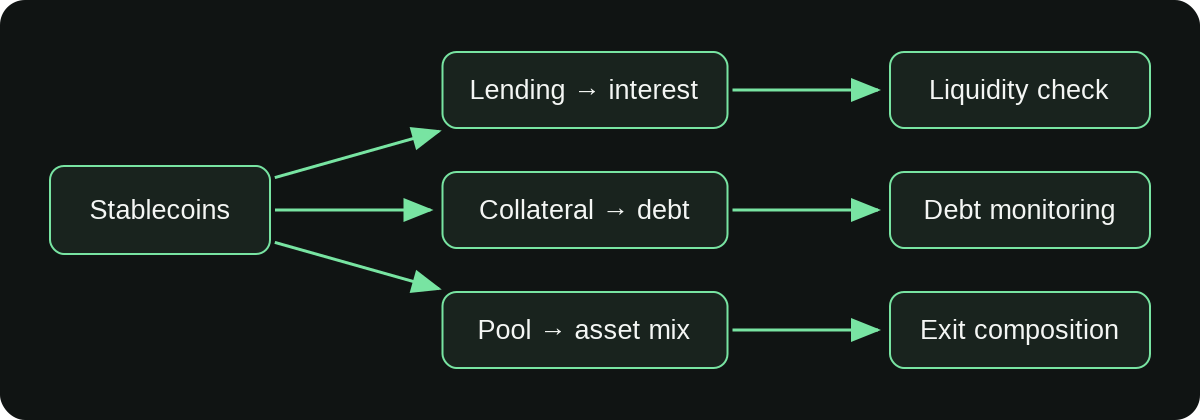
In DeFi, stablecoins can be supplied to lending markets, used as collateral or deposited into liquidity pools. Those activities create different claims and risks. A dollar-linked price does not make the resulting position equivalent to a savings account.
Start by identifying exactly what you are doing with the token. Supplying funds, borrowing against them and providing a two-token trading position are not interchangeable ways to “stake stablecoins.”
Follow the source of the return
A return needs an economic source. Lending income generally comes from borrowers. Liquidity-provider fees come from swaps through the pool. Incentive tokens come from a distribution program that can change or end. A vault may combine several strategies and charge its own fees.
Ask what would happen to the yield if token incentives disappeared. This separates underlying activity from temporary subsidies. An annualized figure extrapolates a rate over time; it does not guarantee that rate will persist or that the token’s dollar value will remain stable.
Also identify what you receive after depositing. It may be a receipt token, vault share or recorded position with a claim on underlying assets. The exchange rate between a share and its assets can differ from one token per dollar.
Your exit depends on the product’s mechanics. Review withdrawal liquidity, queues, cooldowns, contract permissions and any minimum amount before comparing annual percentage figures. A lower advertised return with understandable access conditions can suit a task better than an opaque higher number.
Lending without borrowing is different from collateralized debt
A lender supplies liquidity to a market and accepts risks associated with that market. Available withdrawals can depend on unborrowed liquidity. If most supplied assets are already lent out, a displayed account balance does not establish that the full balance can be withdrawn immediately.
Aave’s risk documentation identifies software, oracle, collateral, liquidity and network risks. These categories explain why an audited lending protocol still requires judgment; an audit cannot ensure that markets remain liquid during a shock.
If you also borrow, your supplied assets may support a debt position. A fall in collateral value or growth in debt can make that position eligible for liquidation. That is a different risk from simply holding an unborrowed supply position.
The Aave V3 health-factor documentation provides a market-specific way to assess borrowing safety. Use the correct deployment and parameters rather than applying a screenshot from another chain. A ratio calculated using an assumed one-dollar price can become misleading when the oracle or market treatment changes.
Before borrowing, model both sides of the balance sheet. A stablecoin used as collateral can fall while another stablecoin owed remains near a dollar. The label “stable against stable” does not remove liquidation risk.
Liquidity pools exchange your asset mix over time
A liquidity provider makes assets available for other users to trade against. As traders swap, the composition of the provider’s position changes. Returns therefore depend on fee income, asset prices, liquidity design and the eventual withdrawal mix.
A stablecoin pair can look uneventful while both assets trade near their targets. During a depeg, traders may remove the stronger asset and leave more of the weaker one in the pool. Your original equal-value deposit does not promise an equal-value withdrawal.
Uniswap’s explanation of impermanent loss describes the comparison with holding the assets separately. Concentrated liquidity adds a chosen price range; moving outside it can change token exposure and stop fee earning until relevant trading returns to the range.
Do not interpret “impermanent” as a guarantee of recovery. The price relationship may not normalize. Fees can offset some losses, but whether they do is a calculation using your actual position, not a feature promised by the word stablecoin.
Compare positions using the same withdrawal date
Prepare a position sheet with deposit quantity, asset price, receipt units, accrued income, incentive value and costs. Compare what you could withdraw and sell today with what holding the original assets would now be worth.
For illustration, suppose a deposit initially worth $1,000 earns rewards worth $12 but its withdrawn assets sell for only $970 before those rewards. With $7 of transaction costs, the combined result is $975. That is a loss despite a positive rewards display. These numbers are hypothetical and do not describe a measured protocol return.
This approach prevents a common accounting error: celebrating token-denominated interest while ignoring losses in the underlying asset. It also keeps gas, management fees and exit spread visible in the result.
For short holding periods, fixed costs matter more. A strategy can show an attractive annualized percentage yet produce little income over a few days. Compare expected income over your intended duration with realistic entry and exit costs.
Inspect dependencies before connecting a wallet
Use official protocol documentation to identify the deployment and contracts. Review whether the position depends on an oracle, bridge, external custodian or another protocol. A vault interface can hide several layers of exposure behind one deposit button.
Limit approvals to the task when practical, and separate a spending wallet from longer-term storage. Read both transaction requests and signatures. Cancelling a browser connection does not necessarily cancel an existing token allowance.
Set a monitoring plan before depositing: what conditions would lead you to reduce exposure, where you would verify an incident and how you would fund the exit transaction. Borrowers need particular attention to collateral conditions. Passive-looking interfaces do not eliminate active obligations.
The storage guide addresses keys and permissions. The depeg impact guide explains how the same price move can affect a wallet, debt position and payment differently.
Questions beyond the headline yield
Can receipt tokens themselves be used elsewhere?
Some applications accept them, but that adds another contractual and technical layer. Confirm whether withdrawal from the first position remains possible after the receipt token is pledged or transferred to a second application.
Does a protocol’s total value locked tell me my withdrawal will succeed?
No. Aggregate deposits can include borrowed, restricted or differently deployed assets. Examine available liquidity for your specific market and the conditions attached to your own position.
Can I set a fixed future income target from today’s APR?
Only as a scenario with stated assumptions. Utilization, incentives, prices and costs can change. Budget essential expenses using dependable resources rather than an extrapolation from a variable on-chain rate.