
Stablecoins can move value across borders, but a successful remittance ends when your recipient can use the money. Compare the full purchase, blockchain transfer and local payout route before choosing it over a conventional transfer service.
Stripe’s remittance explanation outlines purchase, wallet transfer and local cash-out as separate stages. Sending a dollar-linked token is not automatically sending dollars to a bank. Your family may receive an asset they must sell, on a network their preferred service does not accept, with fees they did not expect.
Start with the recipient’s destination
Ask whether the recipient needs cash, a bank deposit or tokens they already know how to use. Then work backward to a lawful, available payout provider. Establish its supported token and network, identity requirements, minimum deposit and payout currency before buying anything.
A wallet address alone does not answer these questions. Someone can control an address yet lack an affordable way to turn the token into local spending money. They may also need the network’s native asset to make a later transaction.
For a relative unfamiliar with wallets, compare a regulated transfer service that handles both ends. A technically cheaper blockchain route can become expensive when a recipient needs several conversions or help recovering a mistaken deposit. Convenience belongs in the comparison alongside price.
Compare recipient proceeds using one common budget
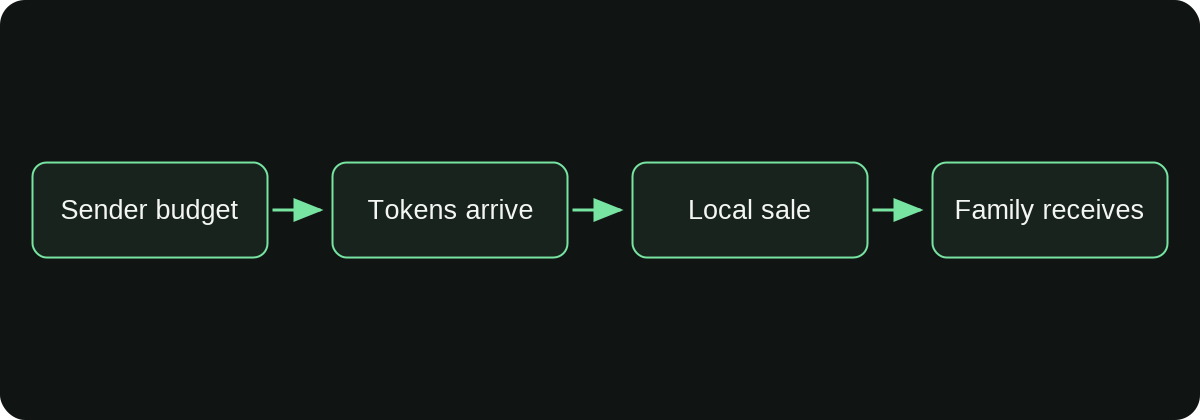
The useful comparison is how much local currency arrives for the same sender outlay, by the same deadline. Network fees are only one component. Include acquisition spread, trading fees, withdrawal charges, payout exchange rate and receiving-bank costs.
A reproducible worksheet is:
Recipient proceeds = tokens arriving × executable local selling rate − payout charges.
Calculate tokens arriving after every upstream deduction. If gas is paid separately, add it to the sender’s total budget rather than subtracting it again from token quantity. Avoid counting one fee twice.
For illustration, suppose a $500 total budget leaves 496 tokens after purchase and sending costs. At a hypothetical local quote of 25 units per token, with a 20-unit payout charge, the recipient gets 12,380 local units. These are invented inputs demonstrating arithmetic, not a current exchange rate or provider quote.
Compare that result with the bank transfer quote available at the same moment. A better-looking token price can lose its advantage through a weaker local payout rate. If quotes expire before the blockchain transfer settles, calculate a conservative range instead of promising an exact amount.
Confirm the corridor before sending
The sender’s country, recipient’s country and service providers all affect access. Account verification, sanctions screening, transfer limits and source-of-funds checks may apply. A working app or wallet does not establish that every proposed use is permitted locally.
Save the actual quote, payout conditions and support route. The CFPB’s remittance guidance identifies exchange rate, fees, recipient amount and availability time as important disclosures for covered US transfers. Do not assume those statutory protections attach identically to a self-directed wallet transaction overseas.
Explain who can help if a transfer stalls: the sending provider, receiving provider or bank. Blockchain confirmation only proves a stage in the journey; it does not make all other parties responsible for completing the payout.
Perform a small end-to-end test
A useful test includes the local payout, not just a token appearing in a wallet. First verify the recipient address through a trusted channel. Match the network and token contract against the receiving service’s instructions. Check whether an additional reference or account identifier is required.
Send an amount above the service’s deposit minimum but small enough to limit mistakes. Wait for the required confirmations and account credit. Have the recipient complete the intended withdrawal or conversion before considering a larger transfer.
Do not scale a test mechanically. A larger transaction can trigger different limits, liquidity conditions or verification requests. Recheck the final quote and account status each time. If the recipient changes an address through an unexpected message, verify the change independently.
For a first wallet transfer, the buying guide helps identify the asset and network. The bank cash-out guide covers the receiving side in greater detail.
Plan for timing and failed stages
Break the expected duration into funding, purchase, withdrawal processing, blockchain settlement, platform credit and bank payout. A fast chain cannot eliminate a bank holiday or compliance review. Avoid scheduling essential rent or medical payments around a best-case settlement estimate.
If a transfer is delayed, identify the last completed stage. No transaction hash usually means the sending service has not broadcast it. A confirmed hash without account credit points toward receiving-service conditions. A completed sale without bank receipt requires the withdrawal reference and bank investigation route.
Keep screenshots of terms, order confirmations and relevant messages alongside transaction hashes. Never send a seed phrase to support. A legitimate investigation may need public transaction details and identity verification through official channels, not control of your wallet.
Decide whether the route remains practical
Stablecoin remittances are most useful when both ends understand the asset and have dependable conversion access. They are less convenient when the recipient needs immediate cash, cannot complete verification or would rely on an unfamiliar informal counterparty.
Also consider the currency risk after receipt. A dollar-linked token can retain its dollar target while moving against the recipient’s currency. Keeping it for weeks changes the task from remittance delivery to holding a foreign-currency-linked asset.
Write down an alternative payout route and the circumstances that would make you use it. That gives your family a decision they can follow if a provider pauses withdrawals or changes its terms, without improvising under pressure.
Questions families often ask
Can I send stablecoins to someone who does not have a bank account?
Possibly, but they still need a lawful and usable destination for the value. Check whether a locally available cash-payout service supports the route and what identity documents it requires before transferring tokens.
Does splitting a payment into many transfers make it safer?
It can multiply fees and create recordkeeping problems. Do not divide transfers to evade reporting, screening or service limits. A small operational test serves a different purpose from disguising a larger payment.
Which records should we keep if the transfer is a family gift?
Keep sender and recipient details, date, purpose, purchase and payout receipts, exchange rates and transaction hashes. Gift reporting and tax treatment depend on the relevant countries; a family relationship does not automatically remove documentation obligations.