
Institutional stablecoin adoption is best assessed through the specific function, eligible participants and evidence of operation. A bank partnership, settlement pilot and public product launch are different achievements. None automatically establishes universal retail access or industry-wide cost savings.
This update examines selected developments checked on November 26, 2026, then provides a due-diligence method for deciding what the announcements mean for a business or institutional user.
DBS and Circle: a defined institutional access development
DBS’s November 18, 2026 announcement describes eligible institutional clients minting and redeeming USDC through DBS, with 24/7 USD–USDC settlement. It presents an infrastructure route connecting banking and stablecoin operations.
The eligibility qualifier is material. It should not disappear when the story is summarized as broader access in Asia. An individual reader or an institution outside the arrangement cannot infer an automatic right to use it.
The functional significance is the primary route: participating institutions may be less dependent on buying or selling through secondary markets for every USDC requirement. That does not eliminate token, counterparty or operational risk.
For a potential customer, the next step is to obtain the actual service conditions, supported entities and implementation details. A news release explains the announced capability; account documentation determines whether it can solve your organization’s task.
Visa and Lloyds: a completed pilot with bounded evidence
Visa’s September 30, 2026 release reports a seven-day live pilot in which Lloyds settled $750,000 of obligations with Visa using stablecoins. The company reports funds reaching Visa in under an hour, including over the weekend.
That is evidence of a defined test, not a published promise that every future transaction completes within the same time. The period, amount and participants should remain attached to any quoted result.
The pilot addresses settlement between institutions. It should not be described as proof that all consumers paid merchants directly with stablecoins or that every merchant received tokens. Customer checkout and interinstitutional settlement can use different instruments.
Nor does completion alone establish the full commercial cost. Integration, funding, custody, compliance and exception handling need to be considered before comparing the route with an incumbent process.
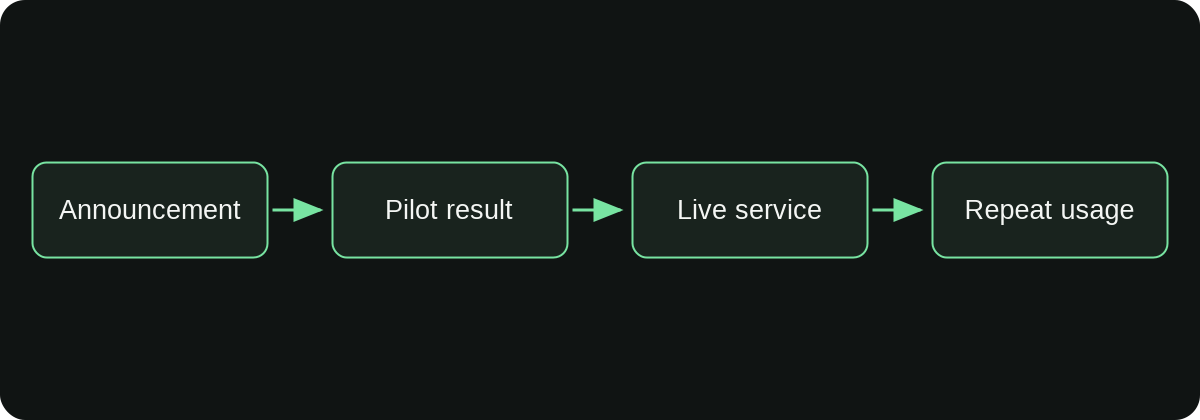
Classify the claim before evaluating adoption
Use four evidence levels. An announcement establishes what an organization says it intends or has done. A pilot report adds a bounded operational result. A production service adds ongoing availability under defined terms. Repeat customer usage adds evidence that the service solves a recurring task.
These levels do not imply that every organization must publish the same data. They help you avoid describing potential as measured adoption. A partnership with no disclosed transaction volume should remain a partnership, not an invented market-share figure.
Company sources are primary evidence for their own announcements. They are not independent verification of every commercial claim. Attribute the reported result and separate your inference from it.
For example, a weekend settlement test can support the hypothesis that a route addresses bank-hour friction. It does not establish that all funding and payout activities for all participants are now continuously available.
Ask treasury questions that the headline cannot answer
Start with the balance-sheet task: funding an account, settling an obligation, holding working capital or paying a supplier. Define the amount, frequency, currency and latest acceptable completion time.
Then establish how fiat becomes tokens and how tokens become usable fiat again. Identify the institution responsible at each stage and whether funds must be prefunded. A fast transfer can still require significant idle balances elsewhere.
Check operational coverage outside ordinary hours. Who can approve a transaction, respond to an incident or process an exception on a weekend? Continuous network operation does not mean your organization has continuous staffing or every counterparty has continuous access.
Finally, document legal and accounting treatment. The token’s issuer, custodian and settlement provider may be separate entities. A treasury decision should identify the claim and exposure created at each point, rather than grouping everything under a technology label.
Measure the complete process if you run a pilot
Define the start and end of the measurement. Time from blockchain broadcast to confirmation is different from time between funding approval and beneficiary availability. Both can be useful, but they should not be compared without labels.
Record transaction costs, currency conversions, failed attempts, manual work and exception resolution. A route that works well for a small prearranged transfer may behave differently during a larger or less predictable flow.
Use a comparable baseline. The same currency pair, amount and service window matter. Comparing a weekend token test with an unrelated high-fee retail wire does not establish savings for institutional settlement.
Include withdrawal and incident exercises where authorized and appropriate. A pilot focused only on the happy path can miss the costs that appear when a destination is unsupported or a compliance review interrupts the process.
These are evaluation criteria, not results from a test performed for this article. No transaction, customer integration or provider performance benchmark was conducted here.
Read adoption alongside concentration and resilience
More institutional participation can improve access while increasing dependence on certain issuers, banks or infrastructure providers. Track the failure paths rather than assuming institutional branding makes the entire route independent.
Ask what happens if a token loses its peg, the chosen chain is unavailable or the bank relationship changes. A fallback must be operationally usable, not merely another logo in a presentation.
For reserve evidence, use the current report directory. For an asset’s effect on lending or payment obligations, the depeg impact guide separates positions with different constraints.
What the selected announcements support
The DBS development supports a specific claim about institutional USDC access. The Visa–Lloyds release supports a reported live settlement test with disclosed boundaries. Together, they illustrate different stages and functions within adoption.
They do not justify a universal claim that stablecoins are cheaper, faster or available for every business. A useful institutional decision connects the documented capability to a real workflow and tests the missing assumptions.
The market outlook places those mechanisms alongside demand and constraints. It avoids turning a short list of announcements into an unsupported forecast of total future adoption.
Questions for business readers
Does an institutional partnership make the token a bank deposit?
No. Distribution through a bank does not by itself change the legal nature of the asset. Read the product documents and distinguish any bank balance from the token or custody claim created in the process.
Should a pilot success rate be applied to production volume?
Not without examining the sample, conditions and later operating evidence. A small controlled trial can establish feasibility while leaving scaling, exception handling and availability questions unresolved.
What if a vendor will not disclose a comparison baseline?
Treat its savings claim as incomplete for your decision. Ask for the assumptions or evaluate your own workflow against a consistent alternative. An untestable percentage should not replace a cost model.