
Stablecoins can expand through trading, payments and institutional settlement, but growth is not guaranteed and token supply is not the same as useful payment adoption. A sound outlook tracks demand, access and resilience rather than inventing a future market-cap target.
This analysis uses dated evidence checked on November 26, 2026. It offers a monitoring framework and conditional scenarios, not a price forecast or a claim that stablecoins should appreciate against their target currency.
Establish a baseline before telling a growth story
The Federal Reserve’s November 13, 2026 Financial Stability Report describes stablecoin market capitalization as remaining around $310 billion over the preceding year. That is a report observation, not a precise live November 26 total.
This matters because a narrative about rapid adoption can coexist with flat aggregate supply. Existing tokens may circulate more frequently, distribution may shift among issuers or a new use case may grow while another shrinks.
Before comparing periods, fix the definition: which tokens, which networks and whether bridged representations are counted separately. A provider changing its coverage can create apparent growth without equivalent new issuance.
The market-cap guide explains the measurement problem. For an outlook, use a stable series and label any breaks rather than joining incompatible headline figures into a trend.
Trading demand remains different from payment demand
A stablecoin can be used to quote crypto markets, settle transactions or hold funds between trades. Demand from those activities may respond to market volatility, exchange access and preferences for particular collateral or quote assets.
Payment demand has another set of drivers: recipient acceptance, conversion cost, availability outside bank hours and the ability to integrate with existing systems. A business choosing a settlement tool is solving a different task from a trader choosing a quote asset.
Measure those uses separately where reliable data permits. Aggregate blockchain transfers can include exchange reshuffling, arbitrage, bridges and internal operational movements. They should not automatically be described as purchases of goods or remittances.
A high transfer count also does not establish economic value per user. Look for recurring use that completes a real payment or settlement task, with defined participants and a clear measurement method.
Institutional access is a catalyst, not a universal forecast
DBS’s November 18 announcement with Circle describes issuance and redemption access for eligible institutional clients. It is evidence of a particular infrastructure development, not automatic access for every retail customer.
Such arrangements can reduce some operational friction for participating institutions. Whether they produce sustained adoption depends on integration, demand and the economics compared with existing routes. A partnership alone cannot quantify future market size.
Similarly, a completed settlement pilot can demonstrate technical and operational feasibility within its scope. It does not prove that every commercial customer has adopted the route or that the economics remain superior at larger scale.
The separate institutional news guide examines how to read those announcements. An outlook should use them as evidence for a mechanism, not as a substitute for measured results.
Costs and local constraints can limit expansion
A transfer’s network fee is only part of its cost. Funding, spreads, withdrawals, compliance operations and local payout can erode the apparent advantage. Thin local liquidity can make a technically efficient route unattractive for its recipient.
The IMF’s August 2026 remarks on emerging markets discuss how corridor conditions and stablecoin premiums affect the result. This supports comparing complete routes rather than assuming one blockchain fee determines remittance competitiveness.
Regulation can also expand confidence while limiting particular services or raising operating costs. Its effect depends on the regime, entity and use case. Neither “more regulation guarantees growth” nor “regulation eliminates adoption” is an adequate general explanation.
Currency preferences matter too. Dollar-linked assets can be useful for some cross-border tasks while creating exchange-rate exposure for local expenses. An expanding dollar-token market is not automatically an improvement for every user or domestic monetary system.
Follow a small set of indicators consistently
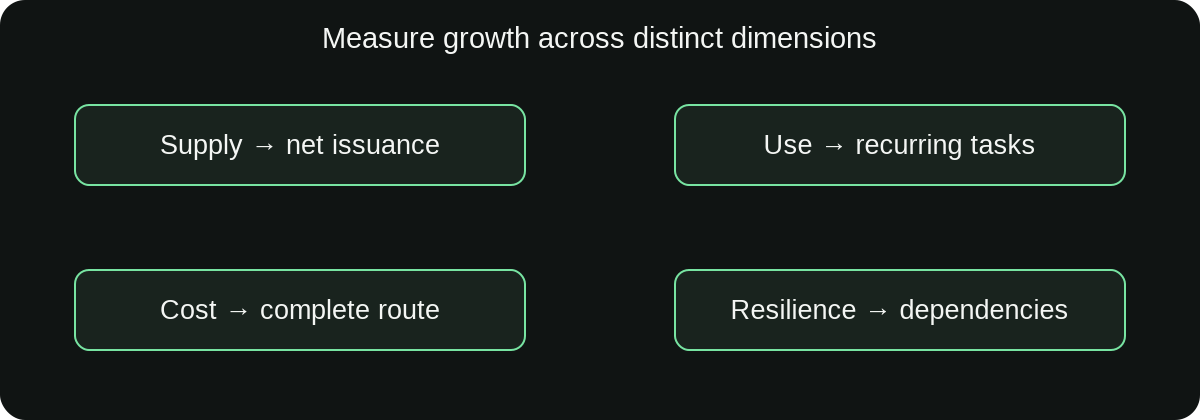
Track net issuance alongside redemptions, not only the ending supply. Compare recurring active use with gross transfers. Monitor executable market depth and issuer access during both ordinary periods and disruptions.
Reserve reporting and operational concentration belong in the same dashboard. A growing market can remain dependent on a few issuers, banks, chains or exchanges. More tokens do not necessarily mean more independent ways to absorb a shock.
Use this interpretation grid:
| Observation | Possible explanation | Next check |
|---|---|---|
| Supply rises | New demand or inventory accumulation | Where issued tokens are used |
| Transfers rise with flat supply | Higher turnover or internal activity | Activity classification and repeat usage |
| New partners are announced | Distribution potential | Eligible users and actual production flows |
| Spreads widen | Liquidity or confidence stress | Size-specific quotes and redemption status |
These are hypotheses to investigate. Do not infer one explanation mechanically from a single metric.
Use conditional scenarios instead of false precision
An expansion scenario would involve repeat customer use, lower complete-route costs and dependable access. Evidence against it could include stalled integrations, unused issuance or rising payout friction.
A consolidation scenario could feature growth in some applications while aggregate supply stays relatively flat. That would not mean every new initiative failed, but it would weaken a claim of uniform market expansion.
A stress scenario could combine liquidity pressure, reserve uncertainty or restrictions on important intermediaries. Its severity would depend on the actual dependencies and response mechanisms. Avoid assigning invented probabilities or token recovery prices.
Update the scenario when evidence changes. State which observation altered the outlook rather than merely refreshing the publication date. A useful analysis tells readers what to watch and why, even when the future cannot be quantified responsibly.
Questions about interpreting growth
Does stablecoin growth mean the token price should rise?
Not against the reference value for a functioning stablecoin. Growth normally concerns circulation, use or services, while the token’s design seeks stability. An issuer’s equity or governance token is a separate exposure.
Can rising supply be called new investment entering crypto?
Not automatically. Issuance can reflect inventory, transfers among arrangements or nontrading uses. Establish the flow definition before treating a supply increase as fresh speculative buying power.
Should I trust a long-term forecast without its method?
Treat it as an unsupported estimate until assumptions, definitions and evidence are provided. A precise number does not become reliable because it is expressed to several decimal places or attributed to an unnamed model.