
The important stablecoin regulatory developments are dated changes to issuer requirements and service access, not a blanket declaration that all stablecoins are approved. As checked on November 26, 2026, US implementation and EU supervisory action require different user responses.
This update separates what authorities have published from what a specific exchange or issuer has implemented. An announcement can establish a future obligation without making every service available today.
United States: distinguish the final rule from its effective date
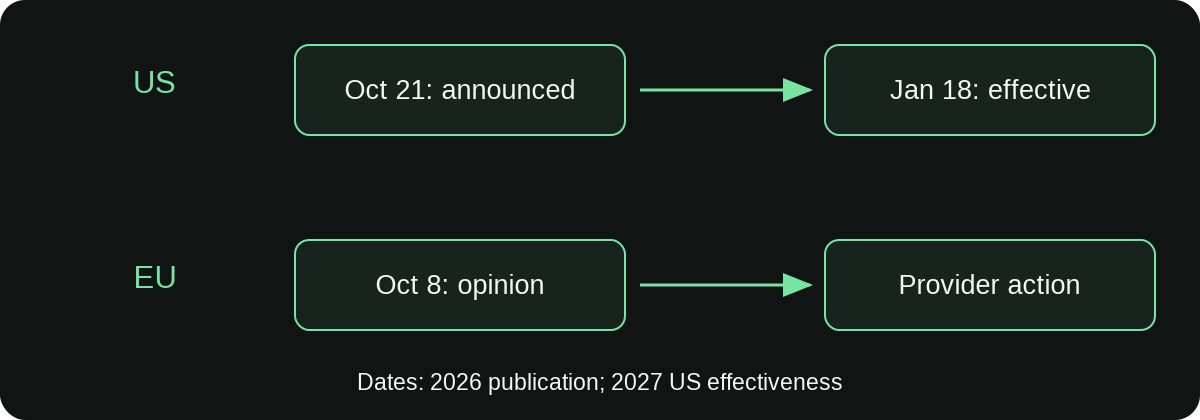
On October 21, 2026, the Office of the Comptroller of the Currency announced its final GENIUS Act rule. The announcement states that the rule and Act take effect on January 18, 2027.
The stated scope includes permitted payment stablecoin issuers and foreign payment stablecoin issuers under OCC jurisdiction, plus specified custody activities. The OCC also identifies separate coordinated rulemaking for Bank Secrecy Act, anti-money-laundering and sanctions matters.
For users, the immediate distinction is between a published framework and a particular firm’s regulatory status. Do not infer that an issuer has completed an application or received permission merely because a rule now describes the route. Check the named entity and relevant official record.
A provider may update onboarding, disclosures or product conditions ahead of an effective date. Read those account notices directly. A change in service terms is not necessarily a new statute, and a future statutory date is not a promise that your account will gain a new feature then.
European Union: service access is the current practical issue
ESMA’s October 8, 2026 opinion announcement addresses services involving non-MiCA-compliant stablecoins. It calls for national authorities to prevent continued or expanded client access and require remediation of remaining exposures as soon as possible, within three months of publication.
The announcement allows only tightly limited, supervised continuation needed for activities such as conversion, withdrawal or safekeeping. That is not an indefinite exemption for ordinary service provision.
A holder should therefore inspect the platform’s own notices, supported exits and relevant supervisory instructions. The opinion should not be turned into a claim that possession of every affected token is itself universally criminal. Its service-access implications and the legal treatment of a personal holding are different questions.
Read regulatory news through four separate layers
The first layer is the legal instrument: legislation, a binding implementing measure, supervisory opinion or consultation. They do different work. A proposed measure should not be described as an effective rule simply because its headline uses decisive language.
The second layer is the relevant entity. A brand can operate through several companies, each serving different users. A permission granted to one subsidiary does not automatically transfer to every affiliated product or jurisdiction.
The third layer is the asset and service. Issuing a token, providing custody, executing trades and paying rewards raise distinct questions. Evidence about one activity may not answer another. Read the scope before using words such as approved or banned.
The fourth layer is your transaction. Residence, customer classification, supported network and payment route determine how the change reaches you. Someone using a different subsidiary can receive a different account notice without either notice being false.
Keep a dated change log rather than a vague compliance score
For each development, record the issuing authority, publication date, effective date if stated, affected activity and next verification step. This produces something you can update when an application, transitional measure or service restriction changes.
| Development | Date to preserve | User check |
|---|---|---|
| OCC final-rule announcement | October 21, 2026 | Relevant entity and implementation status |
| Stated US effective date | January 18, 2027 | Current conditions before that date |
| ESMA supervisory opinion | October 8, 2026 | Platform-specific access and remediation notice |
| Provider account communication | Date received | Actual deadline and available exit |
The last row is deliberately separate. A provider can choose a shorter operational timetable or have obligations tied to its circumstances. Do not replace a notice addressed to your account with a generic date from an article.
Regulation and redemption rights are connected, but not identical
A rule can strengthen requirements without eliminating operational failure. Reserve quality, liquidity, banking access and service availability remain practical issues. Compliance language is evidence to examine, not a substitute for understanding your claim.
The MiCA text distinguishes stablecoin categories and provides specific requirements for e-money tokens. Do not assume every dollar-targeted design falls into the same category or offers an identical redemption mechanism.
When you see a new authorization headline, ask what changes for holders: a new legal counterparty, different redemption terms, additional disclosure or merely a future plan. If no concrete effect is identified, the headline may matter less to your immediate task than a change in withdrawal support.
For the holder-level EU workflow, see the MiCA user guide. For interpreting financial evidence separately from regulatory status, use the reserve-proof guide.
What to verify before acting on an update
Find the original authority publication rather than relying exclusively on a social post. Match the headline to the underlying document, then check whether a later document changes its meaning. Keep a copy or dated reference for important decisions.
Next, obtain the service provider’s current terms for your own account. Confirm accepted assets, conversion options, withdrawal conditions and support channels. Avoid using inaccurate residence details or another person’s account to get around a restriction.
If a deadline affects an asset you hold, investigate the exit while normal service remains available. Moving tokens to another chain or protocol does not necessarily resolve an issuer or legal-access problem and can introduce new costs.
The useful outcome is a verified action list, not an emotional prediction about prices. News about supervision can influence markets, but it does not establish that any particular token must rise, fall or maintain its peg.
Questions readers ask about regulatory headlines
Does a US development change the rules for an EU resident automatically?
No. Identify which issuer, service and jurisdiction are involved. International firms can respond commercially to overseas changes, but that does not make one authority’s rule the law everywhere.
Is an authority consultation useful before it becomes final?
Yes, as evidence of proposals and unresolved questions. Label it accordingly and track the final outcome. Do not describe an option under consultation as an existing customer obligation.
How often should a news article be refreshed?
Refresh when a material rule, effective date or provider implementation changes. Preserve the previous date and explain the substantive update; changing only the timestamp does not make old reporting current.