
Collateralized stablecoins rely on assets intended to support their value; algorithmic designs rely more heavily on rules and market incentives to balance supply and demand. Many arrangements combine mechanisms, so the useful question is what can absorb losses when confidence disappears.
Do not decide safety from a category name alone. Asset quality, redemption access, liquidation capacity and dependence on another token determine whether the stabilization story remains credible under stress.
Ask what a holder can obtain by exiting
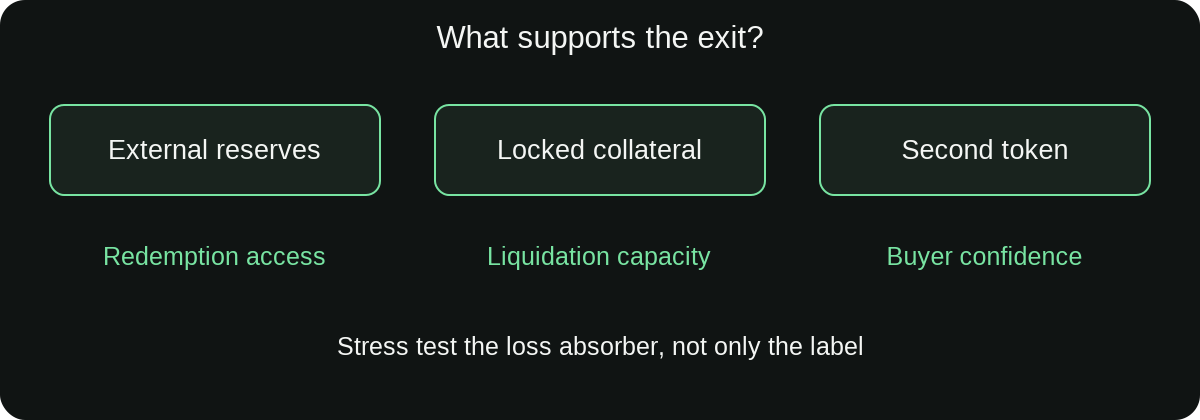
Start with the asset or claim available when someone gives up a stablecoin. Can eligible holders receive bank money from an issuer? Can a borrower repay debt and unlock collateral? Can a user exchange for another token whose price must hold up for the mechanism to work?
These are materially different exits. A market sale to a willing buyer is also different from an issuer or protocol conversion. If the only exit depends on someone else paying the target price, ask what motivates that buyer during a run.
The Federal Reserve’s explanation of stablecoin mechanisms distinguishes stabilization arrangements and their run risks. Its central analytical value is examining how the mechanism behaves when demand falls, rather than treating a dollar label as the answer.
Reserve-backed issuance depends on assets and access
A fiat-reserve-backed arrangement generally holds assets against issued obligations and provides a contractual redemption route. The relevant examination includes reserve composition, ownership, custody, valuation and the terms available to eligible holders.
Cash, Treasury securities and other assets do not all have identical liquidity or risk. Nor does a report showing assets above defined liabilities establish that every retail customer can redeem directly on demand through every intermediary.
For example, Tether’s published direct redemption terms include a substantial minimum, while a smaller holder may sell through a market. That illustrates the difference between the mechanism supporting a token and the route available to a particular person.
The potential weakness is not only an asset shortfall. Delayed banking access or a queue can create a mismatch between holders wanting cash now and the arrangement delivering it later. A solvent-looking snapshot and an immediately liquid exit answer different questions.
Crypto collateral adds liquidation mechanics
In an overcollateralized borrowing design, a user locks assets whose value initially exceeds generated debt. The buffer is intended to absorb price movements and costs. If collateral falls too far, liquidation can be used to address the debt.
The mechanism depends on valuation and execution. An oracle must supply usable prices; a network must process transactions; liquidators need incentives and capital; markets need buyers for collateral. A percentage buffer cannot protect against every combination of gaps, delays and illiquidity.
A simple illustration shows the distinction. Collateral worth $150 supporting $100 of debt provides $50 of gross value above debt initially. If its realizable value falls to $90, the original excess no longer exists. Costs and timing can make the outcome worse than a clean price chart suggests.
Do not treat this arithmetic as a protocol-specific liquidation model. Real thresholds, penalties and asset rules differ. Its purpose is to show why an opening collateral ratio cannot be presented as permanent protection.
Algorithmic incentives can become circular
An algorithmic mechanism may expand or contract token supply to encourage trading toward a target. In a two-token design, the stablecoin may be convertible into a variable quantity of another token. The arrangement then depends on demand for that second asset.
If confidence falls in both assets, creating more of the second token may increase supply faster than buyers absorb it. A nominal one-dollar conversion formula does not necessarily produce one dollar of realizable external value.
The SEC’s June 2024 Terraform statement documents the fraud verdict and the collapse of UST and related tokens after the May 2022 depeg. That episode should not be described as an ordinary temporary discount that all stablecoins eventually reverse.
It also shows why testing a mechanism requires more than repeating its published formula. Ask what happens when arbitrageurs refuse the offered asset, liquidity shrinks and the backstop falls alongside the stablecoin.
Hybrid designs need a dependency map
A stablecoin can combine collateral, algorithmic controls, hedging and governance changes. The label hybrid does not establish that risks cancel. Some components may share the same failure driver, making apparent diversification weaker than expected.
For a hedged arrangement, inspect counterparties, margin requirements, market access and funding costs. For collateral that is itself another stablecoin, trace the second issuer and redemption conditions. For real-world assets, identify the legal claim and operational route to the proceeds.
The DAI–USDS guide illustrates why current token and protocol relationships matter. A design associated with decentralized infrastructure can still depend on centralized assets or services. Classification needs to follow the actual arrangement.
Use a loss-absorption test before relying on the peg
Write down three stress questions. First, who takes the initial loss when backing falls? Second, what asset can fulfill exits if many holders leave together? Third, which actions remain possible if a key counterparty or network stops working?
Look for evidence that answers those questions: defined obligations, current collateral details, realistic liquidation routes and documented authority to change parameters. A promotional statement about stability does not replace any of them.
Then connect the mechanism to your use. A payment due tomorrow requires dependable near-term access. An experimental protocol position requires understanding its technical and economic constraints. The same risk can be tolerable for one purpose and unacceptable for another.
For the financial evidence behind an arrangement, use the reserve-proof checklist. If a peg has already broken, the incident response plan prioritizes immediate obligations rather than a theoretical category debate.
Questions that expose classification mistakes
Does using smart contracts make a stablecoin algorithmic?
Not necessarily. Contracts can operate a collateralized system too. Classify the economic support and exit mechanism, rather than assuming all software-based issuance belongs to one category.
Can a stablecoin’s mechanism change after launch?
Some arrangements permit changes through governance or issuer terms. Review the permitted changes, implementation evidence and notice process. An older classification can become incomplete when collateral, conversion rules or responsible counterparties change.
Are two tokens with the same target equally suitable as loan collateral?
No. A lending market can value them differently or accept only one of them. Its risk parameters depend on factors such as liquidity and price reliability. Shared denomination does not create identical borrowing capacity or liquidation treatment.