
MiCA affects which stablecoins and services EU providers can offer, and it establishes specific rights for covered token holders. To understand your position, identify the issuer, token classification and platform entity rather than relying on a general “MiCA compliant” badge.
This guide focuses on practical checks for a holder. It does not treat a stablecoin as a bank deposit or assume that every asset using a stable price target has the same legal structure.
Identify the token category and legal counterparty
MiCA distinguishes e-money tokens, which reference one official currency, from asset-referenced tokens and other crypto-assets. The category matters because the applicable issuer duties and holder rights differ. Marketing terminology alone does not settle the classification.
For an e-money token, read the issuer’s white paper and redemption terms. Confirm the exact legal entity, its relevant authorization and its contact details through official records. A platform displaying the token may be a separate counterparty with separate obligations.
Write those names into your own record. If something goes wrong, “the stablecoin company” is not a precise complaint recipient. Identify who issued the asset, who holds it for you and who executes any conversion into bank money.
Understand the issuer claim without promising instant cash
MiCA Article 49 gives e-money-token holders a claim against the issuer and provides for redemption at par on request, subject to the relevant framework. It requires redemption conditions to be stated in the white paper.
That legal right is different from an exchange order. Selling to a buyer at a market price can involve a spread or trading charge. Issuer redemption follows the issuer’s process. Compare the two routes without assuming that a legal par claim guarantees an immediate retail market fill at precisely one unit.
Check required identity information, where to submit a request and the supported payment destination. If a custodian holds the tokens, understand whether you must withdraw them first or use the custodian’s redemption arrangement. Do not send tokens to an unverified address claiming to process redemptions.
Keep evidence of the request and the applicable terms. A meaningful claim needs a practical route for communication and dispute handling, especially when your immediate account relationship is with an intermediary.
Check your provider’s present access conditions
ESMA’s October 8, 2026 service opinion is relevant when a platform restricts non-compliant stablecoins. Its remediation approach does not justify assuming normal trading or custody will continue indefinitely.
Ask your provider which functions remain available for your account: buying, selling, conversion, transfers or withdrawal. An asset remaining visible in a portfolio does not establish that new purchases are allowed. A withdrawal option likewise does not prove that every destination or network is supported.
Read the effective date in the platform’s notice and save it. The provider may use a timetable linked to its specific obligations. If different messages appear in an old FAQ and a newer account notice, obtain clarification through official support before relying on the older text.
A service restriction should not be described casually as a universal criminal prohibition on holding tokens. But moving to a website with weaker controls is not a reliable way to solve an access problem. You may exchange a regulated-service issue for a counterparty or fraud risk.
Verify a compliance statement in context
Look for the official record naming the entity and permitted activity. Then compare it with the legal entity shown in your account agreement. A recognizable brand name or a subsidiary’s status can otherwise create a false impression about the service you actually use.
Do the same for the asset. Confirm its native contract and network through issuer documentation. A bridged or wrapped representation can add another claim; it should not inherit every statement made about the native issuance simply because its ticker is similar.
Circle’s bridged-USDC explanation illustrates why token provenance matters independently of market price. Treat that technical identification as a separate check from the legal status of the issuer and intermediary.
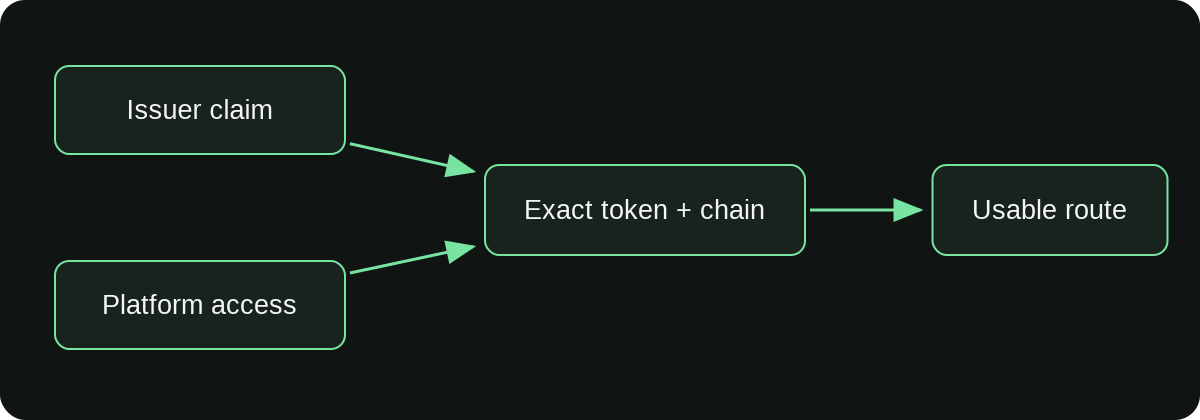
Avoid using a self-published logo as the whole verification. The useful evidence is a consistent chain from official authorization to account entity to the exact service and token. If that chain breaks, ask for the missing information rather than filling it with an assumption.
Distinguish legal protections from investment risk
Regulatory duties do not stop market discounts, network congestion, mistaken transfers or wallet compromise. A provider can be subject to rules while a transaction remains technically irreversible or delayed. Legal recourse and practical access are related but different protections.
Nor should you infer deposit insurance from a token’s currency reference. A stablecoin held in a crypto account is not automatically an insured deposit in your own name. Examine the actual legal structure rather than extending protections from an issuer’s banking relationships.
When comparing rewards, identify the payer and activity. Holding a base token, lending it to a protocol and receiving a promotional platform reward are different arrangements. A compliant-looking token can be placed into a separate product with additional risks.
The DeFi guide explains those additional layers. For current publication dates and the US comparison, use the separate regulation update.
Prepare a usable record before you need support
Keep the white paper version, account agreement, relevant authorization reference and important platform notices. Add transaction hashes, deposit records and redemption-request confirmations when you act. These records make it easier to establish what you held and which service was involved.
If access changes, work backward from the asset’s intended use. Can the permitted conversion or withdrawal route meet your payment deadline? Will the receiving service credit the exact token? Does an alternative require another contract approval or bridge?
This approach turns a broad legal topic into a concrete decision. You do not need to predict the whole stablecoin market to establish whether your existing balance has a lawful and workable exit through your current provider.
Questions about scope
Does MiCA replace every national tax rule?
No. Asset regulation and taxation are different subjects. Your residence, transaction type and domestic rules determine reporting obligations; a token’s regulatory classification does not complete a personal tax analysis.
Is a token white paper the same as an authority guaranteeing its value?
No. A disclosure document explains an arrangement and relevant obligations. It should be read for its content and scope, rather than treated as a government promise against losses.
Can a non-EU provider’s website settle whether I am covered?
Not by itself. Establish which entity serves you, where the relevant services are provided and what the applicable rules require. Website accessibility is not conclusive evidence of authorization or customer protection.