
USDT is commonly quoted in crypto P2P markets because it provides a dollar-linked trading unit that many participants can reuse across exchanges and wallets. That convenience does not prove it is the best available asset in every country or that a particular merchant is trustworthy.
P2P popularity is a market feature, not a safety certificate. To understand a quote, separate the token, the platform’s escrow and the local payment between buyer and seller.
A reusable quote asset reduces some trading friction
A merchant who repeatedly buys and sells crypto benefits when other participants recognize the same settlement asset. A widely accepted dollar-targeting token can reduce the need to negotiate a fresh exchange into a volatile asset for each transaction.
The relevant advantage is compatibility: can the merchant obtain the asset, quote it in local currency and transfer or sell it through another usable route? More counterparties can improve price discovery, but the actual depth depends on currency, payment method, amount and account eligibility.
Do not replace that explanation with an unsupported claim about exact market share. A visible group of USDT advertisements does not establish the proportion of all P2P trading worldwide. Compare the offers available for your transaction rather than repeating an undated popularity statistic.
A token’s stable target also does not eliminate its own issuer, network or liquidity risks. It simply changes the price exposure compared with using an asset such as bitcoin as the intermediate trading unit.
P2P combines two different settlement legs
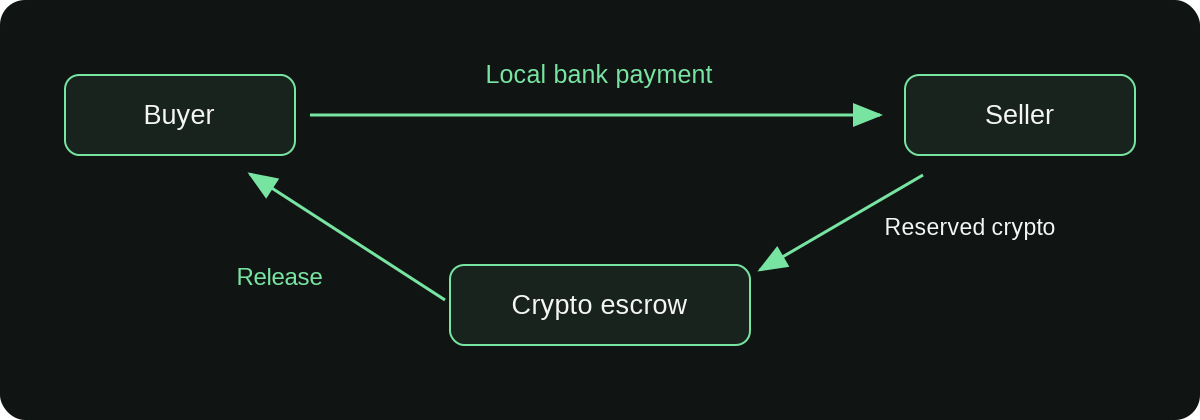
The buyer and seller arrange a local-currency payment while the platform coordinates release of crypto. The bank payment and crypto release do not occur through the same system, so evidence for one leg does not automatically prove completion of the other.
Binance’s P2P introduction describes reserving crypto in escrow during an order. Its fee discussion also notes variation by market and possible payment-provider charges. Those mechanics should not be described as a guarantee against every bank dispute or fraud scenario.
The practical question for a seller is whether payment actually arrived under acceptable conditions before crypto is released. A buyer’s screenshot or message is not equivalent to checking your own bank account.
For a buyer, sending the payment does not justify cancelling a paid order merely because the seller asks. Follow the platform’s current dispute process and preserve evidence. Keep communications within the order where required by the service.
A dollar target is not the same as the local P2P rate
A merchant’s local-currency quote can differ from a simple interbank foreign-exchange conversion. Funding costs, payment speed, inventory, fees and local supply and demand can influence the offered price.
A useful comparison is:
Effective local cost per token = total local money paid ÷ tokens actually received.
For illustration, paying 10,100 local units to receive 100 tokens costs 101 units per token. If a comparable conventional dollar reference is 100 local units, that quote carries a 1% premium before any additional costs. The numbers are hypothetical and do not describe a country’s current rate.
Do not subtract a displayed spread again if it is already embedded in the quote. Compare complete totals for the same token quantity, payment method and time. An attractive headline rate attached to an unusable minimum amount is not your executable price.
Escrow protects a process, not the entire financial relationship
Escrow can reduce the risk that a seller simply refuses to provide the reserved crypto after receiving payment. It does not make all external banking transfers irreversible or prevent authorities and banks from investigating suspicious funds.
A seller can face problems if the payment comes from an unrelated account, carries a disputed origin or conflicts with the platform’s rules. A buyer can be deceived into sending to an incorrect beneficiary or leaving the official order flow.
Read the service’s current name-matching, appeal and payment policies. Do not accept instructions to disguise the purpose of a transaction, use another identity or move the discussion to a private channel to avoid review.
The same caution applies when a merchant has a verification badge. History and verification can provide useful signals, but neither replaces the actual order conditions or evidence of payment.
USDT is not a universal direct-dollar redemption account
A holder may sell USDT through a market without being eligible to redeem directly with its issuer. Tether’s fee schedule includes a $100,000-equivalent direct redemption minimum, subject to relevant service conditions.
This distinction helps explain the role of local intermediaries. A retail user buying a small amount is often relying on a marketplace exit rather than personally accessing issuer redemption. Assess that marketplace’s local liquidity and rules accordingly.
It also explains why “one token equals one dollar” is an incomplete cost statement. A target, an issuer process and your local executable P2P quote are three separate reference points.
For a comparison of issuer routes, see the USDT–USDC guide. If the objective is bank money rather than a token balance, the cash-out checklist follows settlement to the final credit.
Check availability and legality for the actual route
A platform listing a payment method does not establish that every resident can use it or that every bank permits the proposed activity. Review the service entity, local restrictions, bank conditions and applicable reporting obligations.
P2P is not a dependable way to bypass identity verification, sanctions or foreign-exchange rules. A route that depends on inaccurate information can create account and legal problems beyond the immediate trade.
Before selecting an offer, compare completion history, order limits, pricing and relevant terms. Keep enough records to explain the payment and token receipt later. For cross-border family payments, assess the recipient’s final proceeds rather than assuming a cheap purchase completes the remittance.
Questions beyond choosing an advertisement
Does paying more guarantee a safer merchant?
No. A premium may reflect costs or inventory rather than reliability. Evaluate the merchant’s available signals and the order’s conditions independently of price; expensive offers can still be unsuitable.
Can I compare two offers with different payment methods directly?
Only after accounting for charges, settlement conditions and whether you can use each method. Faster availability or different dispute treatment can make the same nominal token price economically different.
Can an advertisement’s price change after I create an order?
Distinguish the advertisement shown before ordering from the terms recorded for the created order. Check the platform’s rules and your order confirmation. Do not agree to an unexplained extra payment outside the documented process because the public advertisement later changed.