
A stablecoin depeg occurs when its market price departs from its intended reference value. The cause can range from a local liquidity imbalance to impaired redemption or a failing stabilization design. The size of one displayed discount does not identify the cause by itself.
For a dollar stablecoin, first verify that the quote is actually expressed in dollars or a suitable dollar reference. A change against another currency or another stressed token can create a misleading impression of what happened to the original dollar peg.
Measure the departure consistently
For a price P and reference R, percentage deviation is (P ÷ R − 1) × 100. A hypothetical price of $0.992 against a $1 target is a −0.8% deviation. This is arithmetic, not an observation about a current stablecoin.
There is no universal percentage or duration that gives every token the same economic meaning. A brief discount in a thin pool differs from a persistent departure across major markets. State the venue, quote asset, timestamp and whether the observation is a last trade, midpoint or executable bid.
If a token trades against USDT and USDT itself moves relative to dollars, the pair price needs additional interpretation. A one-to-one pair quote does not prove that either asset remains worth one bank dollar. Check the relevant currency conversion and independent reference where available.
Distinguish a local price problem from broader stress
A local venue can have shallow liquidity, an imbalanced pool or a transfer interruption. Those conditions can produce a price that differs from another market. The discrepancy matters to someone using that venue even if the issuer’s broader redemption process is functioning.
Compare compatible observations on more than one credible route. If deposits or withdrawals are suspended, an apparent arbitrage may not be executable. A price gap that looks easy to close on a screenshot can persist when assets cannot move between venues.
The swap guide explains how pool price, minimum output and order-book depth affect the user’s actual conversion. A chart’s latest print should not be treated as the amount available for an entire holding.
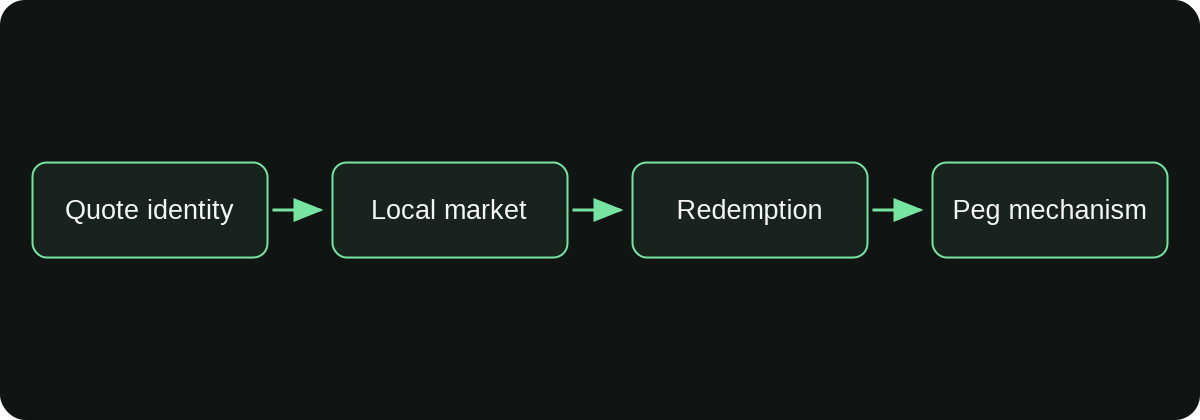
Inspect the mechanisms that normally restore the peg
In a reserve-backed design, eligible participants may buy discounted tokens and redeem them, or acquire new tokens when market prices are high. That process depends on access, costs, banking operations and the credibility of the redemption arrangement.
A crypto-collateralized system may instead use collateral management, liquidations and governance controls. A synthetic or algorithmic design can depend on hedges, incentives or related assets. The correction mechanism can weaken precisely when market conditions become most adverse.
Identify which mechanism is under pressure. A temporary banking delay, a doubtful asset valuation and a broken incentive loop are different problems. Do not label every departure a routine buying opportunity simply because some historical pegs recovered.
Learn the right lesson from March 2023
The Federal Reserve’s analysis of the SVB episode describes how uncertainty around Circle’s bank reserves contributed to USDC stress in March 2023. It is a historical case in which access to part of the backing and expectations about redemption became important to market pricing. Current decisions require current issuer disclosures; a dated crisis summary is not a substitute.
The lesson is that reserve composition and access can matter even for a fiat-reserve stablecoin. It is not a guarantee that a later issuer, collateral structure or crisis will follow the same recovery path. A design must be evaluated on its own obligations and operating facts.
Likewise, a past recovery does not establish that all holders received the same outcome. Some users sold at discounts, while others faced application-level consequences. A token’s later price chart cannot reconstruct every individual loss or liquidation.
Trace the consequences for the holding you actually have
A wallet balance can remain numerically unchanged while its market value declines. Ten thousand tokens priced at $0.90 have a displayed value of $9,000 before execution costs, even though the wallet still contains ten thousand units.
A lending or collateral position can behave differently. The application may use an oracle, a valuation convention or liquidation thresholds that differ from the market the user is watching. A token swap and a debt-repayment obligation can also introduce exposure to different assets.
Map the location of the holding: wallet, exchange, pool, lending market or bridge. Then identify the price and rules that govern that specific position. Solving the issuer question alone does not establish how an application will handle the token during stress.
Assemble evidence before choosing a response
Check the official issuer or protocol notice, available redemption routes, reserve evidence and actual market depth. Look for service interruptions and verify whether the token version is native, bridged or otherwise dependent on another entity.
Separate asset coverage from immediate liquidity. The reserve-proof guide explains why a dated surplus cannot guarantee every payment will clear immediately. Conversely, an operational delay is not by itself proof that the entire reserve is missing.
Avoid letting a screenshot or anonymous claim dictate an irreversible transfer. Evaluate the expected amount received, transaction costs and the risk that a chosen route fails. A supported conclusion can remain conditional when the relevant information is incomplete.
Keep the diagnosis separate from a price prediction
A diagnosis identifies the pressure on the stabilization mechanism. It does not establish the exact future low, recovery time or probability of permanent loss. Those forecasts need additional assumptions and evidence.
For an existing holding, review cash needs and application obligations alongside the token assessment. A user facing imminent collateral liquidation has a different decision from someone holding a small unencumbered wallet balance. The same depeg headline can create different practical priorities without making either decision universally correct.
Frequently asked questions
Can a stablecoin trade above its target as well as below it?
Yes. Demand, issuance constraints and local trading conditions can create premiums. A premium still requires an executable route and cost assessment before it can be called a feasible arbitrage.
Does a zero or missing price field mean the token is worthless?
Not necessarily. The feed may lack data or the market may be unavailable. Verify a genuine quote and the asset identifier before treating a display error as an economic conclusion.
Can a bridge-token discount occur while the native coin keeps its peg?
Yes. The bridge representation can carry additional risks or face separate liquidity problems. Check the exact asset and claim rather than assuming a shared ticker implies identical redemption or market behavior.