
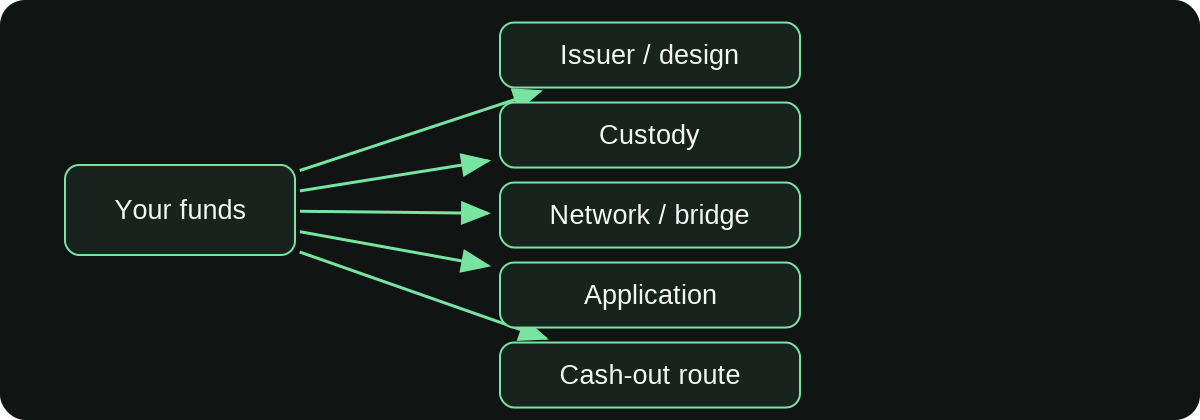
Stablecoins can be useful for particular transfers and trading tasks, but they are not risk-free savings. Their safety depends on the issuer or stabilization design, custody, network, application and exit route. A steady market price can hide weaknesses in any of those layers.
The right question is not whether a stablecoin is safe in the abstract. It is which losses could affect the specific funds, which controls address them and what remains outside your control. Start by tracing the complete route rather than judging only the token’s recent chart.
Follow the funds through each dependency
A user may buy through an exchange, withdraw through a network, approve an application and later convert back through another provider. Each step introduces a different relationship. A reserve-backed token does not remove the platform risk at the first or last step.
Draw the route with the actual entities and contracts. Identify who holds the keys, who owes a redemption obligation and who processes bank withdrawals. If a step cannot be named, the risk assessment is incomplete even when the wallet shows a familiar ticker.
| Layer | Possible loss or restriction | Relevant control |
|---|---|---|
| Issuer or design | Impaired backing, redemption or peg mechanism | Read dated evidence and exit terms |
| Custody | Theft, insolvency or account restriction | Verify provider terms or secure self-custody |
| Network or bridge | Unsupported transfer, disruption or bridge failure | Verify the exact asset and route |
| Application | Exploit, liquidation or withdrawal constraint | Inspect the additional protocol exposure |
| Cash-out route | Poor execution, fees or unavailable banking | Test and price the complete exit |
No single control covers all five. A hardware device can improve signing security without proving reserves, while an independent reserve report cannot prevent a malicious wallet approval.
Evaluate backing and redemption together
Reserve evidence helps assess the assets and obligations under specified definitions. It does not establish identical access for every holder. An issuer’s direct service can require eligibility, verification, a minimum amount and a supported banking arrangement.
Read Circle’s reserve disclosures or the relevant issuer’s corresponding materials with the legal terms. Check the report date, measurement date, subject and independent conclusion. A social-media reserve chart is not equivalent evidence.
Then identify how your own amount can leave. If you rely on selling through an exchange, its liquidity and withdrawal conditions matter. If you depend on a direct redemption, confirm that you can actually use it. A favorable asset total and an unusable personal exit can coexist.
Understand what insurance does not cover
The FDIC’s insured-deposit guidance excludes crypto assets from deposit-insurance coverage. A company using insured banks for some reserve assets does not automatically turn the token in your wallet into your own insured bank deposit.
Similarly, insurance advertised by an exchange may cover specific events, assets or operational arrangements. Read the beneficiary, exclusions and limits rather than interpreting the word insured as a guarantee against every customer loss.
Keep separate the failure of a bank, the failure of a nonbank platform and the loss of a token’s market value. Different legal relationships govern those outcomes. A familiar bank name somewhere in the reserve chain cannot answer all of them.
Protect access without assuming self-custody solves everything
Self-custody places signing and recovery responsibility with the user. It can reduce dependence on one account provider, but exposes the holder to key loss, phishing, malicious permissions and operational errors. It also leaves issuer and token-contract risks intact.
Use a wallet obtained through a verified channel and protect the recovery material. Confirm addresses on a trusted device and avoid signing requests that are not understood. A warning system can help identify threats without guaranteeing that an unflagged action is safe.
MetaMask’s security-alert guidance explicitly distinguishes informational signals from guarantees. Apply that distinction to every wallet’s interface: a successful connection or absence of a warning is not a full assessment of the recipient contract.
Treat yield as a new exposure
A stablecoin balance held without additional use and a stablecoin deposited into a lending market are different positions. Lending, liquidity provision or a platform reward can introduce borrower, smart-contract, liquidity or business-model risk.
Ask where the return comes from and who bears losses if the source fails. A high quoted APR does not explain whether the yield is sustainable, subsidized or exposed to leverage. Withdrawal conditions can matter more than the headline percentage during stress.
Do not assume the peg guarantees the value of a receipt token or investment position built on top of it. The asset may remain near one dollar while a pool, lender or service becomes unable to return the expected amount.
Stress the outcome that would disrupt your task
For a payment, consider a failed transfer, a delayed receipt or an unavailable local conversion. For stored funds, consider a depeg, account freeze or inaccessible wallet. For DeFi collateral, inspect the application’s pricing and liquidation rules.
A hypothetical loss test can show the dollar consequence of a price departure without predicting its likelihood. Test the amount you need, the time you need it and the alternatives available if the intended route fails. Do not label the largest modeled loss the maximum possible outcome.
The depeg diagnosis helps distinguish price, liquidity and design problems. It does not promise a recovery time. A plan that only works if the peg returns before an essential payment leaves a real funding risk unresolved.
Decide what exposure is acceptable
Reduce unnecessary dependencies where feasible, but recognize that diversification needs analysis. Two token symbols held on one exchange can share the same custody risk. Two networks can share a bridge or another service dependency.
Keep near-term obligations separate from funds whose availability can tolerate disruption. The amount appropriate for one person can be unacceptable for another with fewer reserves or a different spending currency. There is no universal safe percentage that a token ranking can supply.
Review the route periodically and after a material notice. A stable price yesterday does not establish unchanged terms today. A useful safety assessment ends with named dependencies, realistic controls and a clear understanding of the remaining risk.
Frequently asked questions
Does a larger market capitalization guarantee better protection?
No. Size can describe circulation or market value without establishing reserve quality, legal rights or available liquidity for a particular order. Evaluate the underlying exposures rather than using scale as insurance.
Can changing my wallet password protect an exposed recovery phrase?
Not by itself. Someone with the recovery material may retain independent control. Use the wallet provider’s genuine recovery guidance and assess moving to a newly secured wallet rather than assuming the local password revokes that access.
Is a small test transfer proof that a route is safe permanently?
No. It can help confirm present operational details. Later conditions, larger-amount limits, issuer events or account reviews can produce a different result, so retain the other checks as well.