
A stablecoin liquidity crisis can mean that holders cannot sell or redeem at a usable price, but the underlying cause may be temporary access disruption or a collapsing stabilization mechanism. The 2023 USDC shock and 2022 TerraUSD collapse should not be treated as the same event.
Comparing them helps answer a practical question: what evidence distinguishes a difficult exit from a deeper failure of the asset’s value-support system?
Separate liquidity from value support
Liquidity concerns how much you can exchange, at what price and within what time. Value support concerns the assets, claims or mechanisms intended to sustain the token’s target. Problems in either can worsen the other.
A thin order book can create a large price movement without establishing an issuer-wide shortfall. Conversely, a busy market can continue trading an asset whose underlying mechanism is failing. Trading activity alone is not proof of adequate backing.
Start by naming the route: an exchange sale, a pool swap, issuer redemption or protocol conversion. A failure in one route does not automatically describe all of them. The underlying cause determines whether another route addresses the problem or merely moves it.
The depeg explanation covers diagnosis, while this article compares historical failure paths and shows how to examine size-specific liquidity.
USDC in March 2023: banking access and market dislocation
The Federal Reserve’s primary-and-secondary-market analysis documents Circle’s March 10 announcement about reserves held at Silicon Valley Bank and the subsequent USDC depeg. It emphasizes differences between issuance/redemption access and secondary trading.
The case illustrates an external banking shock affecting an asset that continued to trade on-chain. A functioning blockchain did not make reserve access and bank processing irrelevant.
For comparison, the key investigation was what happened to the reserve claim and the channel converting tokens into dollars. A market discount alone did not measure the final loss on those reserves.
Do not extrapolate a historical resolution into a promise for another token. The bank-run case study explores that episode’s access and dependency lessons in more depth.
TerraUSD in May 2022: the mechanism itself came under pressure
The SEC’s June 2024 statement on Terraform records the fraud verdict and describes UST and related tokens falling to near zero after the May 2022 depeg. This was not an example of every stablecoin discount reliably reversing.
In a two-token stabilization design, the exit can depend on demand for another token. If that second asset also loses confidence, a nominal conversion formula may fail to produce the external value holders need.
The comparison question is therefore different from asking when a bank reopens. What asset absorbs losses? Who will buy it at sufficient value? Does expanding its supply strengthen the exit or dilute demand further?
The mechanism comparison explains that circularity. It is useful to distinguish the mechanism’s economic constraints from the separate legal findings about a historical project.
Test whether the quoted price supports your transaction size
A last trade can be real but too small to represent your exit. Inspect executable bids or an amount-specific swap quote, including fees and minimum output. Avoid using a single candlestick to infer order-book depth or liquidation distribution.
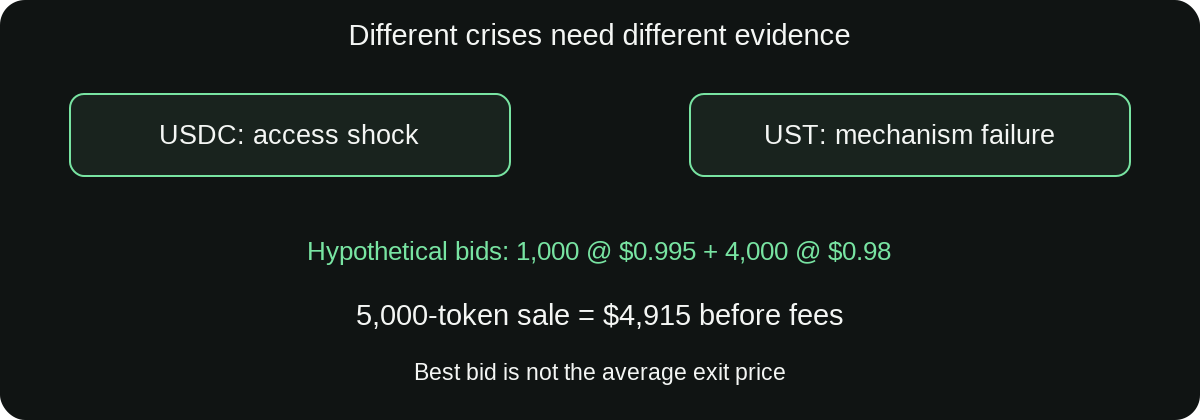
Consider a hypothetical two-level order book. Buyers bid for 1,000 tokens at $0.995 and another 4,000 at $0.98. Selling 100 tokens would produce $99.50 before fees. Selling 5,000 would produce $4,915, an average of $0.983 per token.
The example is invented to demonstrate arithmetic, not a historical market reconstruction. It shows why applying the best bid to an entire balance can overstate proceeds. Actual orders may change before execution.
A DEX requires a pool-specific quote rather than this order-book calculation. The same principle applies: use your size, current liquidity and the actual mechanism. A quote that is attractive for ten tokens may be poor for ten thousand.
Build an evidence matrix during a disruption
Compare several dimensions instead of searching for one decisive screenshot:
| Evidence | Question it helps answer | Limitation |
|---|---|---|
| Amount-specific quotes | What can I receive now? | Conditions can change before execution |
| Redemption status | Can eligible holders access the primary route? | Your eligibility may differ |
| Reserve or collateral information | What supports the claim? | Dates and realizable value matter |
| Official incident notice | What has the operator confirmed? | It may not resolve every uncertainty |
| Network and bridge status | Is the transfer route operating? | Transfer success is not fiat settlement |
Look for consistent explanations across those sources. If they disagree, preserve the disagreement and its dates. Do not manufacture certainty by averaging unrelated claims.
Compare responses by the problem they solve
Changing exchanges can help with venue-specific liquidity, but it does not repair an issuer shortfall. Moving to another chain can change a transfer route, but it may introduce a bridge and leave the same underlying exposure.
Issuer redemption can differ from a market sale, but only if you qualify and the process operates within your deadline. An inaccessible par claim is not immediate cash for a payment due today.
For borrowers, collateral conditions create another clock. For an unleveraged holder, the relevant constraints may instead be essential spending or concentration. The response plan organizes those decisions without assuming one action fits every case.
Afterward, review whether your original route depended on a single bank, venue or conversion mechanism. The lesson from comparing crises is to identify that dependency before stress, not to assume all future events will resemble the better historical outcome.
Questions about stressed markets
Can high volume coexist with poor liquidity?
Yes. Rapid turnover does not guarantee that a large order can execute near the displayed price. Examine spread, depth and price impact for your size rather than substituting aggregate volume for an exit quote.
Does a stablecoin pair quoted at one prove both tokens are sound?
No. Two assets can trade near parity with each other while both weaken against an external reference. Inspect the quote asset and compare with usable fiat or another independently assessed route.
Can temporary trading suspension resolve a backing deficit?
A suspension can change trading conditions or provide time for investigation. It does not itself create reserve assets or fix an inadequate mechanism. Evaluate any announced remedy on its actual economic and legal terms.