
The right alternative to a stablecoin depends on the job: everyday spending, short-term reserves, foreign-currency access, on-chain transactions or speculative exposure. Bank deposits, money market funds, Treasury bills and volatile crypto-assets solve different problems and should not be ranked as interchangeable substitutes.
Start with the outcome and deadline. An instrument can offer attractive income yet be unsuitable for a payment due today, while a convenient on-chain token can be inappropriate for emergency savings.
Separate the task from the asset you currently hold
Write down what you need the money to do, when it must be available and in which currency. Include the recipient or platform if the task involves a transfer. That defines the comparison more clearly than asking which asset is universally safest.
Then identify constraints: account eligibility, withdrawal timing, tax treatment, minimum purchase and supported payment methods. An option you cannot lawfully access or cash out before the deadline is not a practical substitute.
Avoid assuming that moving out of stablecoins must mean taking more market risk. For some tasks, returning to an appropriate bank balance reduces operational complexity. For other tasks, conventional instruments cannot interact with the required on-chain application at all.
The useful choice is therefore task-specific. You may use different instruments for operating payments, longer-term holdings and experiments rather than forcing all funds into one arrangement.
Bank deposits: useful for ordinary payments and accessible reserves
A suitable bank account can provide local payment access and may qualify for deposit protection under the relevant jurisdiction’s conditions. Verify the bank, ownership category, currency, limits and actual protection scheme.
In the United States, the FDIC’s deposit guidance distinguishes insured deposit products from nondeposit investments. Do not extend those rules automatically to an overseas institution or to money held through an unidentified intermediary.
A bank balance can reduce the need to sell tokens before paying a bill. It may still involve transfer windows, currency conversion costs or account restrictions. Compare the service you actually use rather than a generic claim that banks are always slow or always available.
For cross-border needs, obtain a complete quote including recipient proceeds. A bank or payment service can be preferable when the recipient wants cash or cannot safely operate a crypto wallet.
Money market funds: investment shares, not insured savings
Money market funds generally invest in short-term instruments under their particular rules. Investors own fund shares, and the fund’s portfolio, fees and redemption conditions determine the exposure. A stable-looking share value is not the same as a guaranteed bank deposit.
The SEC’s investor bulletin on money market funds explains that they are not FDIC insured and describes relevant risks and redemption conditions. Read the specific prospectus rather than relying on the phrase cash equivalent.
Compare the type of fund and the assets it holds. A government money market fund and another short-term investment product need not have identical risks, fees or access conditions. Availability also depends on the brokerage and jurisdiction.
For short holding periods, consider how quickly proceeds become withdrawable after redemption. Investment liquidity and bank payment availability are related but different stages.
Treasury bills: match maturity to the spending date
US Treasury bills can be relevant to eligible users seeking a defined short-term government-security exposure. They are securities, not crypto tokens or ordinary bank balances. Currency, eligibility, custody and purchase arrangements still matter.
TreasuryDirect’s selling guidance explains that a bill held there must be transferred to a bank, broker or dealer to be sold before maturity. This is an important access condition for someone assuming instant liquidation.
Holding to maturity differs from selling early at a market price. Match the planned maturity and settlement process to the date you need spendable money. Do not treat a quoted yield as a guarantee about an early sale’s proceeds.
A tokenized fund or security linked to Treasury assets introduces its own wrapper and intermediary conditions. It should not automatically inherit every feature of directly holding a Treasury bill through a conventional account.
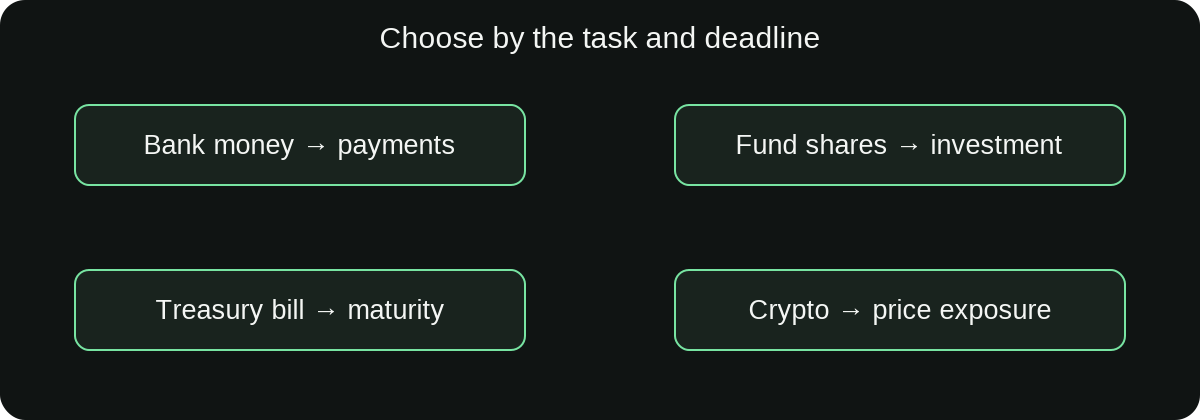
Other crypto-assets change the purpose and risk
Bitcoin, ETH and similar assets may serve investment, network or application roles, but they are not stable-value replacements for a fixed near-term obligation. Replacing a dollar-targeted token with a volatile asset introduces price exposure.
That can be an intentional investment decision, but it should be recognized as such. A token’s independence from a particular stablecoin issuer does not eliminate market, custody or network risks.
A proposed CBDC is another category again. It is not necessarily an available option for your account today, and it does not become an investable presale token. The CBDC comparison separates central-bank money from private claims and project announcements.
If the task requires an on-chain asset, first establish which assets the application accepts. A conventional bank balance cannot be substituted directly for collateral in every protocol. But moving into a tokenized alternative may add a new legal and technical layer.
Compare alternatives with a decision sheet
Use five fields: target currency, claim, access time, costs and failure path. Record the exact product rather than the broad category. That avoids comparing a specific stablecoin’s weaknesses with an idealized alternative.
For emergency spending, focus on dependable access and payment acceptance. For short-term investment, examine maturity, price risk and net return. For a cross-border transfer, compare the recipient’s usable proceeds. For an on-chain interaction, verify exact asset support and permissions.
Do not diversify by label alone. A bank balance, fund and token can still depend on the same institution or currency. Conversely, using several currencies can reduce one concentration while increasing exchange-rate uncertainty for local expenses.
The stablecoin selection guide helps when the task genuinely requires a stablecoin. The remittance guide compares a payment route rather than an investment return.
Questions before moving funds
Should I sell everything at once when changing instruments?
There is no universal rule. Consider settlement, access, costs and existing obligations. A transition plan should avoid leaving a required payment unfunded while both the old and new routes are temporarily unavailable.
Can a foreign-currency bank account remove all stablecoin-related risks?
It changes the exposure rather than eliminating every risk. Examine the bank claim, protection scheme, access conditions and currency movement. The relevant comparison is the specific account against the specific token route.
Does an alternative with a higher yield automatically suit idle cash better?
No. Higher income may involve longer access times, price changes or additional counterparties. Match the product to the funds’ purpose and deadline before treating yield as the deciding factor.